
Podcast Episode 009
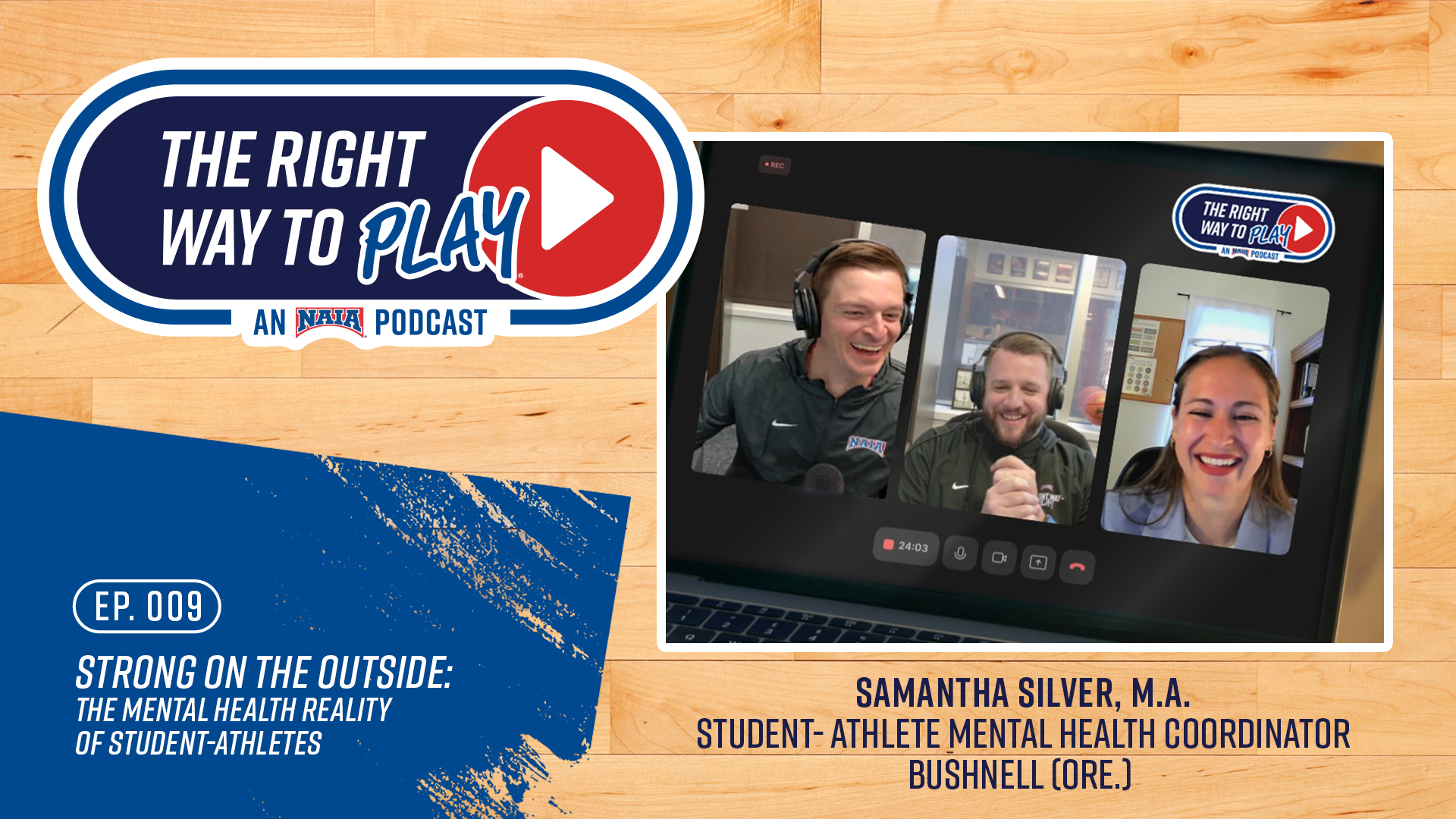


Strong on the Outside: The Mental Health Reality of Student- Athletes
Behind the competition, the pressure, and the performance, there is a side of being a student-athlete we do not always see. In this Mental Health Awareness Month episode of The Right Way to Play® podcast, we sit down with Samantha Silver, former NAIA student-athlete, coach, and now Student-Athlete Mental Health Coordinator at Bushnell (Ore.), to talk about what mental health really looks like in college athletics.
Austin: Welcome to The Right Way to Play Podcast. No hype, no fluff—just real conversations about character-driven competition and the future of college sports. Let’s go.
Alan, here we go.
Alan:
Let's go. It is Mental Health Awareness Month and we are super excited to talk to our guest, Samantha Silver from Bushnell University. And I don't want to get this wrong. So I truly am going to read it because it's that impressive, Austin. Samantha is the student athlete mental health coordinator at Bushnell. She is in charge of leading mental health support for their student athletes. She's had a spectacular career as a softball player as well, ranking in the top all-time and multiple categories for the Beacons. She went on, she earned her master's in clinical mental health counseling and is pursuing her associate license for counseling. But here's the piece I wanted to make sure I didn't miss. While she was a student athlete, she helped launch a wellness program that assigned counselors to each team, removing barriers, building trust. Sam, you're super impressive and we're so thankful to have you on the show today.
Austin: Absolutely. Welcome, Sam.
Samantha:
Thank you so much. I'm excited to be here.
Austin:
No doubt. Well, let's jump right into it. You've obviously seen this from every angle. You've been a student athlete, a coach on the counseling side. Tell us something that people still don't fully understand student athlete mental health.
Samantha:
Yeah, I would say the stigma surrounding student athlete mental health, I think it's talked about sometimes, but there's this expectation as a student athlete to fit a certain mold or to fit inside a certain box that's created by your coach or your family or whatever it may be. But I typically refer to it as the student athlete identity. And so the problem there is that there's someone special hidden behind that student athlete identity. And instead of that specific unique special person and having them benefit your program and grow your program, we're trying to fit them into this student athlete identity and that's I would say the most unfortunate piece is there's that stigma but the expectation to fit the student athlete identity.
Alan:
Interesting. I've never thought of it from that way. Sam, take us a little bit back in time. You you launched, as we mentioned in your bio, this wellness program you were a student athlete. I'm curious, like, what was the spark? Like, what, why? Like, what were you trying to solve? What caused the change in your mind to see this need? Because incredibly forward thinking. I know when I was a student athlete, I didn't. Well, I take that back. was never a student athlete and that's probably pretty obvious.
Austin:
Thanks for the clarification.
Alan:
When I was a student, I wasn't thinking about that sort of thing. I was just trying to survive the day to day.
Samantha:
Yeah, I would say for me, awareness was the big thing that I wanted to bring change around. But there was a specific pivotal moment, I would say, during my junior year where as an athlete, you kind of keep up on everybody who plays, whether it's NCAA, NAIA, kind of looking at a couple of teams that I paid close attention to. And one of them was James Madsen University. And Lauren Burnett was a phenomenal catcher for them.
I remember scrolling after one of my games and finding an article that had said she'd taken her own life. And it was the week after she'd received her conference's biggest award. And I was just shocked. And there was this big push for student athlete mental health awareness. And I was like, yeah, absolutely. And there should be because I as an athlete have experienced similar moments in my life. And I was really excited for this moment of awareness. And after a month or two it stopped. And that didn't sit right with me. And so it sparked this moment for me where I was like, want to build something that is a lasting legacy for change in mental health awareness for student athletes and leaves them with something that is able to help them reach peak performance but also feel like their best self in the end. And so the Student Athlete Mental Health Program idea was born.
Alan:
Sam, can I ask you a quick follow up to that? Like as you were rolling that out to the leadership there at Bushnell and your peers, did you run into any barriers or was it just full on support? And the reason for my question is, know, the NAI is a collection of smaller schools and resources can be limited in time, but I think sometimes you just have to start. And so I'm just curious, like the start, like how did you just get it going?
Samantha:
Yeah. Yeah, so it started with my senior year of undergrad. It just started with an idea and I floated it and then we have what's called vision and call here and I was granted an internship opportunity my first year of graduate school where I was able to just develop a pilot program. And so there was no resources. I was doing it from the ground up and the best part about having the team that I have is Cory and Sarah, our athletic directors, they they backed me 100%. And if I needed advocacy or help in certain areas, they were right there alongside me just helping me navigate all the nuances of trying to build a program in a private university where funding is limited. I would say the biggest roadblock for me was going and trying to fight and advocate for funding for the program. been an uphill battle over the last couple years, but each year I would say the school's battled and advocated for this program to continue since we're on year four now.
Austin:
cool, so cool. So obviously being a collegiate student athlete yourself, there's this idea of being mentally tough in sports, know, just grinding through it, gritting through it, not talking about it. It's part of the journey, if you will, I put that in there quotes. How do you help student athletes navigate that tension?
Samantha:
That is such a good question and there's no easy answer because every individual athlete operates differently. And so I would say first and foremost, I ask them to kind of recognize what is that mentally tough mean to you? Can you describe what it means to me? Define it in your words. What does it mean to be mentally tough? Because for some athletes it lights a fire and it helps them be confident. And then for other athletes it can be detrimental. And so I really them to look at is this aiding you or is it hurting you and biggest goal here is to help you reach peak performance is this going to help and if it's not right now let's reframe and adjust this mentally tough mindset to one that is going to help you and aid you whether it be geared more towards self-confidence or increase of positive self-talk or even just a neutral self-talk and so I really ask them think about your self-talk let's go back to the like we're looking at peak performance. How do you reach it? Are you eating right? Are you drinking water? Are you sleeping right? But biggest thing is do you believe in yourself? And what's the swag that you have when you step into competition?
That also looks different whether you have a quiet, silent type athlete versus somebody who's got a pretty big personality. And so I like to tap into each individual athlete's strengths and capitalize on that to reach peak performance. So not necessarily building into this mentally tough mindset, but giving them the tools to work through things that become barriers for them.
Austin:
That's so cool. And as a follow up to that, so it's kind of on the field, if you will. What about off the field where maybe think of like the freshmen or the transfers that are maybe away from home the first time and maybe talk through how you navigate some of worries or the anxiety of being away from home or being somewhere new or not being the big man on campus or big woman on campus, if you will.
Samantha:
Yeah, absolutely. So I actually don't necessarily look at things as on and off the field. There are some things that are on the field, some things that are off the field. But like I mentioned earlier, that that mindset of student athlete identity, I look at them as a person. I go, tell me about who you are. Tell me about the things that happen in your life, because you're more than just a softball player, baseball player, football player, whatever it may be. You are like looking at myself. I'm like, I'm Sam. That's who I am. I am not a softball player, not anymore. I was, and it was part of my journey, but it doesn't define who I am. I really get to the core of who they are. And then we get to work through the things that are building those walls and keeping them from being the best individual and athlete that they can be. So we look at it as a whole on and off the field. Let's build you up and help you reach peak confidence, peak performance, whatever your goals are, let's go accomplish them.
Austin:
literally have goosebumps right now. This has got me fired up. It's got me passionate. It's just, great answers, Sam. No, it's not.
Alan Grosbach (08:37)
Hahaha!
It's not an easy thing. I think people
think that in, whether it's D2, D3, NEI, let's just say small college athletics,
there's not pressure and there's so much pressure. And
Sam, I'm curious a little
Samantha (Sam) Silver (08:53)
Absolutely.
Alan Grosbach (08:55)
hypothetically say we have a student athlete that's listening that may be struggling for whatever it is. And they don't know what to do or they don't know how to start or they don't know where to go. Like,
what would you say to them if they stepped into your office?
Samantha (Sam) Silver (09:06)
Gosh, what a great question. First, honestly just say asking for help and that initial reach out is the hardest part. And as an athlete, like you mentioned, that mentally tough piece, you've been taught to grind it out and just grit it out by yourself. But what we don't realize is in athletics alone, you have a team of individuals that are built within it that want to help you. And so it's not a weakness to
for help, but instead I would view it as a strength and just allowing the people around you that want to help
built these
bridges to be able to build these connections to reach that peak performance, the
person that you can be, but
you don't know, you don't know. And so if they don't know you need help, one of the things we're really good at as athletes is masking things.
as soon as you mentioned
that question. The first thing I thought of is, man, if someone were to ask, like even ask me, hey, how's it going? My first initial instinct reaction that I'm still working on today is, I'm good, regardless of what's going on in my life, I'm good. And so really kind of helping to tear down those walls that we build up as athletes. Just remember, you don't have to do it alone. There are people who want to come alongside you. want to
you thrive. They want to help you grow and be the best person of yourself you can be. All it takes is finding that trusted person to go to and go,
hey
I'm
not good
and I think I might need some help and there is somebody that wants to step in beside you and go let me shoulder this with you.
Austin Bennett (10:35)
Amazing. I love it. So thinking back to the beginning of this journey for you, if you could go back and challenge coaches, administrators, teammates, and heck, even schools, think about challenging schools during mental health awareness month, what would that challenge be?
Samantha (Sam) Silver (10:48)
Oof. Well, I think it would be different for each one. And so.
I would say for coaches, I would challenge you to see the individual, not just the athlete.
See them as a whole and really encourage them to grow into the person that they are and
to thrive in the person that they are to build your program to be better
instead of trying to fit them into that box that I mentioned earlier.
would say for administration and schools, accountability. If you want students to reach peak performance and you want to build awareness around student athlete mental health,
You have to hold athletic staff accountable to the expectations and the bar that you're going to set. And so would say accountability for sure for administration and
And for teammates, I think this is a big one. I would say be selfless because you never know what the person next to you is shouldering or what they're walking through. And you never know if your smile or your encouragement or your faith in them, your belief in them is what is keeping them showing up every day and keeping them grounded.
and so be selfless and remember that we're all pretty good at wearing these masks and we want to show up for each other because if we're each showing up for each other that support system is going to be wild.
Austin Bennett (11:58)
So good, so good. The challenge has been thrown down schools, teammates and coaches. Hope you're listening and hope you take it. That's good stuff.
Alan Grosbach (11:59)
Yeah, that's amazing. Sam, yeah, let's go.
Sam, I don't know that he said, if he says this outside of, or if he says this at Bushnell, but when Corey is around the national office or championships, he always says, we're just, we're just little old Bushnell. Sam, are, you are obviously a big reason why they're not just little old Bushnell. Like you're, you're incredible. And I thank you so much for joining us today, but now we have our Fast Five.
Austin Bennett (12:21)
100%.
Alan Grosbach (12:29)
So we're transitioning to our Fast Five, lightning round, just quick questions, no overthinking.
Austin Bennett (12:29)
Come on.
Alan Grosbach (12:34)
Just your first gut reaction. Now I've said this multiple times. Typically these turn into like a moderate to slow five, but we're really looking, we're looking for a fast five. And so fast five number one, walk up song. What are you listening to? What are you walking up to if you're stepping into a big game?
Samantha (Sam) Silver (12:49)
Get Behind Me by Emerson Day.
Austin Bennett (12:50)
Mmm, there you go. Nice. Go to reset when you're feeling overwhelmed.
Samantha (Sam) Silver (12:55)
Philippians 413, I can do all things to Christ who strengthens me, 100%.
Austin Bennett (13:00)
Amen.
Samantha (Sam) Silver (13:05)
gosh, definitely my high school coach. He pushed me harder than any coach I've ever had. He had the highest expectations for me, but there was something special about when I reached the lowest point in my career in college.
I was having similar feelings to Lauren Burnett that I mentioned earlier. And he just reminded me this game does not define you. You're built for more than this. And he believed in me with the ferocity I've never felt from any other coach. And I think it helped develop me and turn me into the player I was, but also the person I am today.
Alan Grosbach (13:36)
Austin, the goosebumps are back. I know. Oh my goodness.
Austin Bennett (13:39)
They haven't gone away from me Alan. They've been here since she started talking. Man, whoo! Okay,
I know what my answer would be to this and I think I know what Alan's would be, but for you coffee, energy drink, or nap?
Samantha (Sam) Silver (13:50)
I really like naps, but I'm a huge caffeine addict too, so...
Alan Grosbach (13:57)
Coffee or energy drink then? If we're moving naps because they're wonderful, coffee or energy drink.
Samantha (Sam) Silver (14:01)
Yes,
probably a rebel spritzer.
Austin Bennett (14:05)
Cool, okay, I've not tried one of those. I don't either.
Alan Grosbach (14:06)
even know what that is.
Austin Bennett (14:08)
We've got a lot to, we've now got two things to add to our list when we come out to Bushnell Island, so.
Samantha (Sam) Silver (14:12)
you
Alan Grosbach (14:12)
Right, naps and Red Bull spritzers,
Okay, last Fast Five.
you think right way to play, what's the word you think of or the phrase that you think of?
Samantha (Sam) Silver (14:22)
Passionate. Yeah. Passionate.
Alan Grosbach (14:23)
Goosebumps are back again.
Austin Bennett (14:25)
Well, since you
did this fast like you're supposed to, I'm going to ask you a bonus question.
Say Alan steps into the box in front of you. You're in the circle. Give me the pitch sequence you would throw to
him to strike him out.
Samantha (Sam) Silver (14:34)
Are you a righty or a lefty?
Alan Grosbach (14:36)
I bat left-handed. I'm right-handed, but I would hit left-handed. Yeah.
Samantha (Sam) Silver (14:39)
bat left handed, I'd go
drop ball outside, fastball high and at the hands, or rise ball, and then I'd probably finish with a chain jump and strike out.
Austin Bennett (14:43)
Swing and miss. Swing and miss.
Woohoo! Yeah!
Alan Grosbach (14:49)
You know, wait, I mean, you- I would swing
it all over- I wouldn't foul one off, like...
Austin Bennett (14:54)
No, they'd be in the zone. You'd either
swing or they'd just be in the zone and you take it and it'd be strike one and strike two. Come on, come on.
Samantha (Sam) Silver (14:58)
I'm going with the self-confidence route.
Alan Grosbach (15:00)
Very, I love it. I love it.
That high one at my hands, I'd probably dive out of the box. And then
Austin Bennett (15:06)
You
Alan Grosbach (15:06)
do the old, remember what was it? John Crook against Randy Johnson in the All-Star game where he turned his helmet backwards and moved to the right side. I'd probably do that.
Austin Bennett (15:12)
Yes, yes,
that fits you. That sounds about right for the athlete you are.
Well, Samantha, I say this with all sincerity. This has been my favorite episode so far. Thank you for what you do. Thank you for what you continue to do. The passion you have for what you're doing and moving people's lives on campus is just huge. I can't thank you enough for sharing some of that. And please continue to do that not only at Bushnell, but in all walks of life. Because as a former college athlete,
That really hit me hard with a few things you said
identity piece in particular,
that you're more than just an athlete, you're more than whatever the sport is. So thank you for sharing your message. Thank you for the work you do.
We appreciate your time.
Samantha (Sam) Silver (15:45)
Yeah, thank you so much for having
me. Thank you.
Alan Grosbach (15:48)
All right, Austin, it's time for walk off moment.
This is where we share kind of our thoughts from the conversation. What was your big takeaway with Sam?
Austin Bennett (15:55)
And what keeps coming to mind for me, Alan, is just wow. Like the fact that they've
allowed her
pursue this, to build this, to grow it, and now to execute it. Just good on Bushnell. I know they're probably not the only NAI school or small school that's doing it, but she's the one we talked to, and that's where she's at at Bushnell. So just wow, Bushnell. Way to go. Congratulations. Keep doing it. Keep pushing for awareness and building identity outside of
was a lot more than just one word or one takeaway, Alan,
This kind of came out of me.
Alan Grosbach (16:18)
I think my biggest takeaway is I always feel like in this conversation, you hear this, the comments of there's not enough resources. We don't have enough time or we don't have the right personnel. And I think Sam and what she's done, not only as a student athlete, but now as a professional is like, you're wrong. Like take the time, find the resources, make it happen, get started.
Austin Bennett (16:33)
Yes.
It does matter.
Alan Grosbach (16:38)
then you can immediately be positively impacting people's lives. And that...
Whew,
almost makes me emotional, it's incredible.
Austin Bennett (16:44)
Yes, 100%. Well, college athletics is at its best when it builds more than wins, as we just heard about today. Thanks for being a part of the conversation. I challenge each and every one of you to share this episode with somebody who's an athlete, a coach,
an administrator, or just out of school. Continue to send us your ideas, and we'll keep telling the stories that matter,
because this is the right way to play.
Alan Grosbach (17:01)
Hey, and be sure to follow, subscribe,
NAIA (17:03)
That's a wrap. Good.
Alan Grosbach (17:03)
so make sure you don't miss the conversation.
Austin Bennett (17:04)
Bingo.
Alan Grosbach (17:05)
Whew.
Austin Bennett (17:06)
one take.


