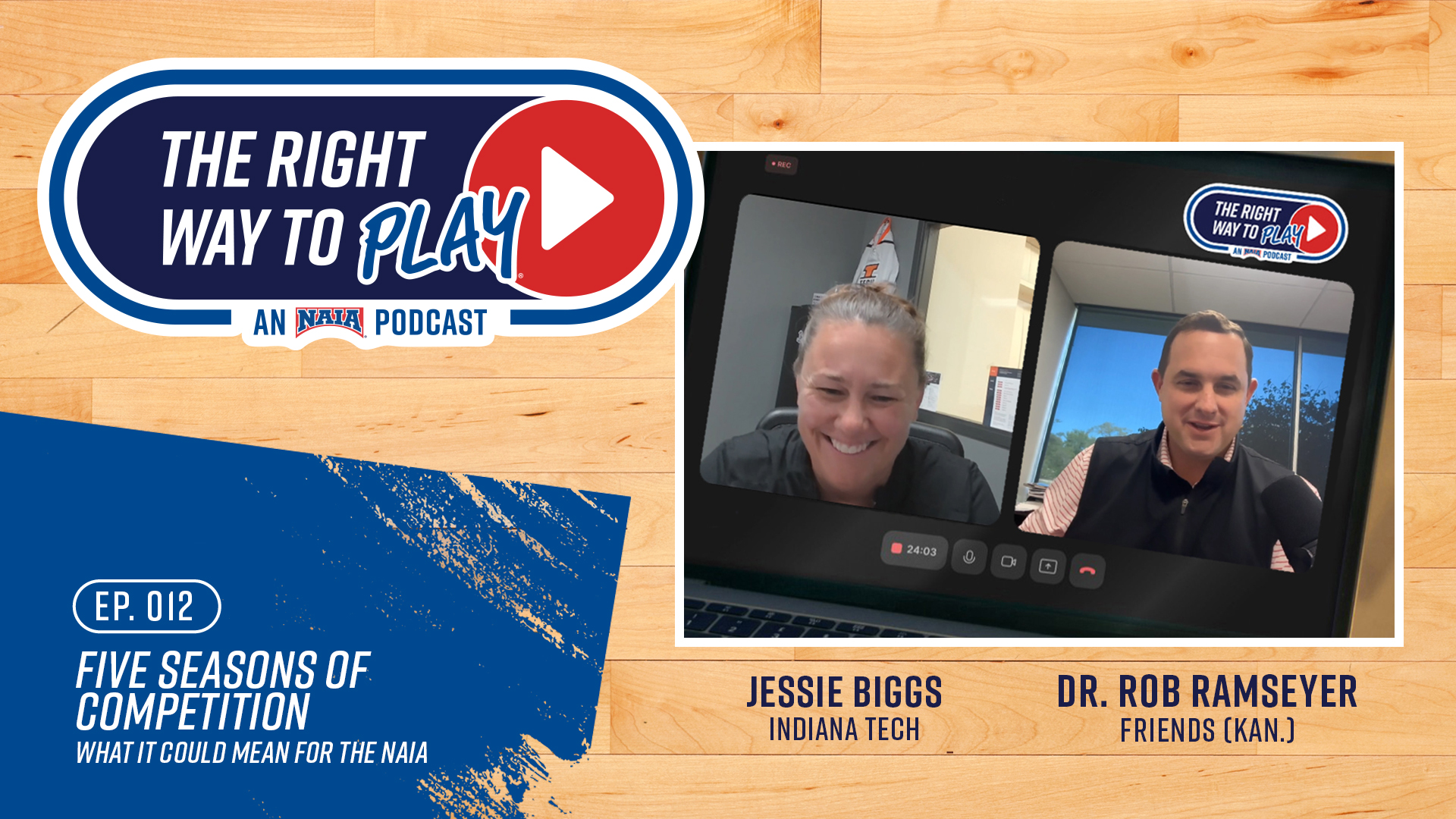
Austin Bennett [00:19] Welcome to The Right Way to Play podcast. No hype, no fluff, just real conversations about character-driven competition and the future of college athletics. Today we’re talking about something every campus leader wrestles with: making better decisions. Whether it’s enrollment, budgeting, staffing, facilities, or student-athlete success. The best decisions aren’t based on assumptions. They’re based on good information. So today we’re exploring how athletic leaders are using data to strategy, demonstrate impact, and help their institution thrive. One of the tools helping make that possible is the NAIA’s Return on Athletics® program. But this conversation is about much more than a report. It’s about leading with confidence. Alan, this is right up your alley, so let’s get started.
Alan Grosbach [01:01] I’m telling you, we’re talking data. I’m this may be the most excited I’ve been for a podcast. We get to be a little nerdy for today. And we’ve got two great leaders in the association joining us. They’ve embraced data on their campus and data-driven decision making. They’ve have used the ROA program, but also leverage other sources to make key decisions for their campus to make sure that both Friends University and Indiana Tech remain successful. And so excited to have Jessie Biggs. She’s the Athletic Director and the Head Women’s Basketball Coach at Indiana Tech. She’s been leading the Warriors for a number of years, and under her leadership, Indiana Tech has won five consecutive Wolverine Hoosier Athletic Conference All-Sport Trophies. They captured their first-ever Learfield Directors’ Cup national title. They consistently earn NAIA Champions of Character, gold, and five-star recognition. And Jessie has helped position Indiana Tech as a premier athletic department in the NAIA.
Austin Bennett [01:51] Yes, and also joining us is Dr. Rob Ramseyer who serves as the Vice President of Athletics and Strategic Expansion at Friends University. An award-winning Athletics Administrator and former NACDA Athletic Director of the Year. Rob has led tremendous competitive, academic, and facility growth while championing innovative initiatives like Impactful Coaching Project. His leadership focuses on developing student-athletes and coaches as whole people. So welcome, Jessie, and welcome, Rob. Thanks for joining us.
Alan Grosbach [02:16] Yeah, welcome.
Dr. Rob Ramseyer [02:17] Thanks, guys.
Jessie Biggs [02:17] Thanks guys.
Alan Grosbach [02:17] So I’ll just I’ll just kick it off and Jessie, Rob, feel free, whichever one wants to jump in first. So athletic directors are juggling a lot of different topics in their role now today. It’s it’s no longer just sport operation. It’s it’s it’s in it’s enrollment goals, it’s finances, it’s student success, facilities, staffing, et cetera. When you think about the role you’re in today, what are some of the biggest decisions you’ve been asked to make and how has it changed in your timeline at your current campuses?
Jessie Biggs [02:46] I got it, Rob. I’ll take this first
Alan Grosbach [02:46] The
Jessie Biggs [02:47] One. Yeah, I think, you know, just over the years, progressively, we really use the ROA and we’ve we were first five years kind of blind what do we do? What are other schools doing, right? Are we are we keeping up with the trend? Are we staying ahead of the game? Should we add this new sport, right? Does it fit into the geographics or what the NAIA is trying to do. So I think My first years in the Indiana Tech that was what it was. And we didn’t have the ROA, right? And so since it’s been in place, we’ve added several new sports. And I think for me, that’s one of the things that I first look at when adding a new sport or thinking about it. Okay, what’s the operating budgets, right? What’s the personnel, what’s the scholarship models? And does that fit us, right? So it has to obviously be growing at the youth level, but we can’t be the only NAIA school, within several hundred miles that has it. So that’s something from a new sport ad that we use it for. And then also sports are different, right? Some need more operating budget to be competitive. Some need more scholarship dollars. How can you restructure your dollars the same amount, but maybe get a competitive advantage or a retention advantage by shifting operating versus scholarship? Relative to the rest of the country,
Alan Grosbach [04:02] Yeah, interesting.
Jessie Biggs [04:03] And making sure that you’re you’re staying competitive. So those are just a little c a couple of things that I’ve tried to put in place the last couple of years and really use it for to stay ahead.
Dr. Rob Ramseyer [04:12] And I’d add very similar to what Jessie said, I think the other big decision we make is how do we structure a system? But I think hiring head coaches is the most important thing I do. And from a student experience standpoint to a competitive standpoint and also a financial, where at Friends, I mean, 35, 40% of our revenue budget is university, is student-athlete tuition. So getting coaches that not only can recruit those students but also give them great experiences where they stay. Become alumni that give back alumni that give it back and just support what we’re doing. So yeah, a lot of a lot of tangents we could go on that question.
Alan Grosbach [04:45] Can imagine.
Austin Bennett [04:46] Well, Rob, we’ll start with you on this one. There’s no shortage of data available today, but not all of it is really useful, especially in certain instances. What are the metrics or insights you rely on most when making strategic decisions for your athletics department?
Dr. Rob Ramseyer [04:59] This is where we geek out and use ROA quite a bit. I mean the this how you model scholarships are so important for your institution, your coaches, your student-athletes, where you wanna press it as much as you can in order to be competitive, but not to a place that puts your school in a bad spot. And I mean, you don’t wanna yeah, put the institution in a place where we’re trying to win and all of a sudden we don’t have any money, no money, no mission and we can’t operate. So using ROA, knowing what reality is, there’s so much noise out there of I know Jesse’s probably the same, every coach we have, everybody else has given more. And to be able to go back to a data source we trust, although it is Alan, so we can question that. But and say, here’s what we’re doing.
Austin Bennett [05:40] Yeah. Fair fairly accurate.
Alan Grosbach [05:40] Ha
Dr. Rob Ramseyer [05:42] Yeah, and we’ve even analyzed, looking at scholarships of okay, here’s our competitive teams that are winning the conference. Here’s the national numbers. And we don’t have to be at the top of everything in knowing what kind of the margin we have to scholarship to give our give our programs a competitive edge, but also providing a net return to the school so we can offer our mit and execute our mission.
Austin Bennett [06:05] Jessie, what about you?
Jessie Biggs [06:05] Yeah, I scholarships is obviously a big one. Another one that I find very interesting and is you know like dollar per student-athlete, right? So operating budget per student-athlete and like how that breaks down. We’re we’re a thousand plus student-athletes, right? So it’s very important for me that obviously our school operates from a lean standpoint and efficiency of how can we maximize this. But for me, a priority is not taking away from that student engagement, right? That student piece, that student experience. That’s very important. So staying in that average, staying where each sport, and each sport is unique and different on what that cost per student-athlete is, but really making sure that we stay on par with that, along with obviously still keeping the institution in a good position has helped me, that data has really helped me. Make sure that all of our sports are in line to do that and we can give our students a really good experience.
Alan Grosbach [07:03] Jessie, I’m gonna jump on top of that question a little bit too towards you. Obviously, Carl, our your president is very involved in the NAIA he chairs our current our COP at the moment, and a very data-driven person. And Rob, I’ve met your president as well, and I know she is also. Can you turn that a little bit into a story? What does that look like when you’re taking this type of data, whether it’s whether it’s through return athletics or whether it’s through an outside source or something you build internally? Like, what does that process look like for those that maybe don’t quite know how to approach their president or their administration with this sort of thing. Like how are you packaging it? How are you communicating it? And how has that maybe changed a conversation on your campus around this balance between like, we there’s the business side of the college, but there’s also like, I think Rob, you said it well, like the mission side too. Like, and so Jessie, how do you approach that with your, with your president and your administration generally?
Jessie Biggs [07:51] Yeah, I think for us, every institution probably has something like Forvis or something that they’re tracking, which is cost per student, right? They’re they’re taking that every student costs X amount, right? No matter depending on how many credits they’re in, how many classes. And that was really kind of what our institution was using to decide if sports were, you know, a good investment. Right. A good do we need to invest more? Do we need to invest less? Are we spending too much? And so bringing in ROA and actually the Return on Athletics®, right? And how much the sports are generating, whether it’s tuition, whether it’s fundraising dollars, that’s really helped us come full circle on our campus and be able to have those conversations of okay, you’re using you’re using this model to track class by cost, expenses, you know, academics. We’re using
Austin Bennett [08:41] Yeah.
Jessie Biggs [08:41] This for Return on Athletics®. And how can we combine it together to paint the whole picture of what our campus looks like? So it’s really every athletic director is probably relatively on par with where they’re at. But to put numbers to that to go into a room with people on your campus that are not familiar with athletics, that’s really helped me, right? I can go in a room and argue all I want, hey, we need this. Hey. This is what our student-athletes need. But without the ROA, I didn’t have any numbers to put to it. Right. And they and they had their model that had all these numbers. So that’s really helped me become full circle in those meetings and be able to actually bring them numbers and say, hey, this is where we’re at. This is where we can get to, or where we I think we should be, and still be okay from a from a net tuition, net return level. So that gap that was maybe like fifteen, twenty percent, we’ve been able to shrink that by about five percent just ’cause we have better numbers, right? So we’ve been able to push the threshold a little bit in those conversations just by having numbers that support it.
Dr. Rob Ramseyer [09:44] Here’s a real practical recent example, Alan, I think, of what your question’s getting at. We’ve used the research briefs you guys have done quite a bit. And one of them was looking at roster size and retention. And I was a meeting with some faculty, I think it was last week. And well, this roster has gone so big, that’s why kids aren’t staying. I go, Well, my friend Alan, here’s here’s the data. And
Austin Bennett [10:03] Mm-hmm.
Dr. Rob Ramseyer [10:03] Actually, we’re in the we’ve worked hard to target kind of being in the retention bands that you all have put out. And Small isn’t always better. Big’s not always better. It’s by sport and being able to reference those, it’s I feel like it’s brought us some credibility on campus of we’re we’re not we’re not making this stuff up. You know, here’s here’s data.
Alan Grosbach [10:20] Right, right.
Austin Bennett [10:21] You look forward to the future of college athletics, what decisions do you think campuses will need to make differently? And maybe how important will data be in helping leaders navigate those decisions? And Rob, we’ll we’ll start with you on this one.
Dr. Rob Ramseyer [10:32] The easy answer is yeah, it matters and matters a lot. And I think we can get so many data points right now. You can probably make the data say anything you want. So the research behind it and kind of finding the signal within the noise of what we listen to and what it is for your institution. Like for example, for us, when we’re putting s together scholarship plans every year, we’ve compared a KCAC or conference, we compare to the NAIA. And we’ve gotten to the point where we know at Friends University, if we’re within this band of scholarship, our teams, it’s our best bet to win, retain, and have good academic performance. And me and our VP of enrollment, Preston Todd, always joke around of we want great students, we want to win, and we also want to spend less money so we can do other things too. And those things are there’s a lot of competing values there, right? So taking all those things and finding our best chance to put us in a position for success in all areas. That’s the that’s the data we’re always trying to analyze and bring out of how do we do it well and use that data. I don’t know if I even answered your question. Did I get there? Okay. Yeah.
Austin Bennett [11:34] No, that was that was good. And Jessie, I’ll pivot a little bit coming to you on this because I think a key part of this is it’s you both have been in your roles for a while. You’re successful at what you do. But say you’re a first-time or a first year, second year athletic director, maybe what’s what’s the sales pitch you would give for Why ROA?
Jessie Biggs [11:49] I think it just gives you a an extremely good average to start to try to aim for. I agree with Rob wholeheartedly. You do not have to be the top scholarship school in the country to win a National Championship or have high level academic or athletic success. Like, I you but you’ve got to be within a range, right? You don’t you can’t be the bottom, but you don’t have to be the top, right? So starting out, trying to just gradually and progressively, I think, get to those averages from a competitive standpoint and an enrollment standpoint. I like the retention piece of it as well. Along with Rob, we also do our sports specific retention goals are set based off of those ROA, the average. So yeah, I would say start to get to try to get to those average, work to there, but you do not have to be the top. In order to be successful. It gives you a really good base layer to have a s very solid athletic department
Austin Bennett [12:46] Great. Love it.
Alan Grosbach [12:47] Yeah, awesome. Okay, we are gonna transition to our “Fast Five”. No overthinking, five quick questions. We’ll look to both of you to answer, and I’m gonna kick it off. Or I’m sorry, Austin, you’re gonna kick it off this time. Just stealing it. I’m just so excited.
Austin Bennett [13:00] I gonna say, wow, I know it’s an ROA podcast, but you don’t I can I still be a part of it, please, Alan? Wow. Man. Okay, first one. First one. And we’ll go Jessie first and then Rob. What’s one word that best describes the value of NAIA athletics?
Jessie Biggs [13:14] Efficient.
Austin Bennett [13:14] Okay. It’s a question mark at the end of that answer, but that’s okay. Rob, what about you?
Dr. Rob Ramseyer [13:18] Values-driven. I’ll give you two words.
Austin Bennett [13:20] Okay. A little bit of cheating, but that’s okay.
Jessie Biggs [13:20] That’s two, Rob. That’s cheating.
Alan Grosbach [13:21] Driven. Yeah, he cheated.
Dr. Rob Ramseyer [13:23] There’s a there’s a dash, that’s one word.
Alan Grosbach [13:24] Typical friends. If you could instantly add one new metric to every athletics dashboard, what would the measure be?
Dr. Rob Ramseyer [13:31] I wanna I wanna see entry characteristics. So like GPA, ACT, all that kind of stuff, and retention. I wanna see those two together.
Jessie Biggs [13:40] Support staff, dollars salary.
Austin Bennett [13:42] Nice. What’s one leadership habit that you never skip?
Jessie Biggs [13:45] People, good people. Give me a good per have good people in our athletic department and we’ll get the job done.
Dr. Rob Ramseyer [13:50] Building relationships every day.
Austin Bennett [13:53] I like it.
Alan Grosbach [13:53] Okay. Coffee before work or a workout before work?
Jessie Biggs [14:01] Coffee.
Alan Grosbach [14:03] Okay.
Austin Bennett [14:04] Okay, and our fifth one, complete this sentence. The future of college athletics depends on
Jessie Biggs [14:09] Is it me?
Austin Bennett [14:10] Yeah, go for it.
Jessie Biggs [14:12] That’s my turn? No God no. Goodness, goodness, no. We’re all in trouble then.
Alan Grosbach [14:11] Sure. It depends on Jessie. There you go. There you have it, Austin. Send that
Austin Bennett [14:13] It does. Wow.
Dr. Rob Ramseyer [14:16] Pretty pretty arrogant.
Austin Bennett [14:18] Mm-hmm.
Jessie Biggs [14:21] I think I think Unity. Okay.
Dr. Rob Ramseyer [14:24] My mind went to creating value in terms of creating value for student-athletes beyond just playing the sport.
Austin Bennett [14:31] I like that. Rob, Jessie, thank you both so much for joining us today and sharing how Friends University and Indiana Tech are using Return on Athletics program to tell a stronger story about the value of college athletics. The work you’re doing demonstrates the data, isn’t just about the numbers. It’s about helping institutions make informed decisions and really strengthen their missions and create a better experience for student-athletes on your campuses. So we appreciate your willingness to share and to join us. And thank you for those insights that I’m sure NAIA membership we’ll take from. So thank you both for joining us.
Dr. Rob Ramseyer [15:00] Thanks, guys.
Jessie Biggs [15:00] Thanks.
Alan Grosbach [15:01] Awesome, it’s time for our walk off moment. What was
Austin Bennett [15:03] On.
Alan Grosbach [15:03] Your what was your takeaway?
Austin Bennett [15:05] Well, first takeaway is I’m really surprised ROA isn’t return on Allen. It’s Return on Athletics. But stuff for those conversations. No, truly, I think the one thing I took away was the data and all that is great. And obviously a lot of people are using it, but the focus is still the students and the student-athletes. So it’s it’s making sure the students are set up for success in so many different ways. And it’s great to hear both Rob and Jessie speak to that piece and how their experience still matters even amongst all the numbers.
Alan Grosbach [15:30] Yeah, I think it was kind of an underlying theme for me of what Jessie and Rob were talking about is that like there’s art and science to running athletic departments. Like science is the data and getting the numbers right, but the art is the pupil and making sure the student experience is right. And that and that obviously these two people balance that really well on their campus, and fit within their campuses missions for athletics, which I think is awesome.
Austin Bennett [15:51] Well said. Well said. Well thank you for listening to the Right Way to Play podcast. If you enjoyed today’s conversation, be sure to subscribe, leave us a review, and share this episode with somebody who believes in the power of education based athletics. Until next time, remember, college athletics is more than competition. It’s about creating opportunity, changing lives, and telling the story the right way. Thanks for listening.
Alan Grosbach [16:11] Thank you.