Austin Bennett
Hello, and welcome to the Right Way to Play podcast. No hype, no fluff, just real conversations about character-driven competition and the future of college sports. Let’s dive in.
Alan Grosbach
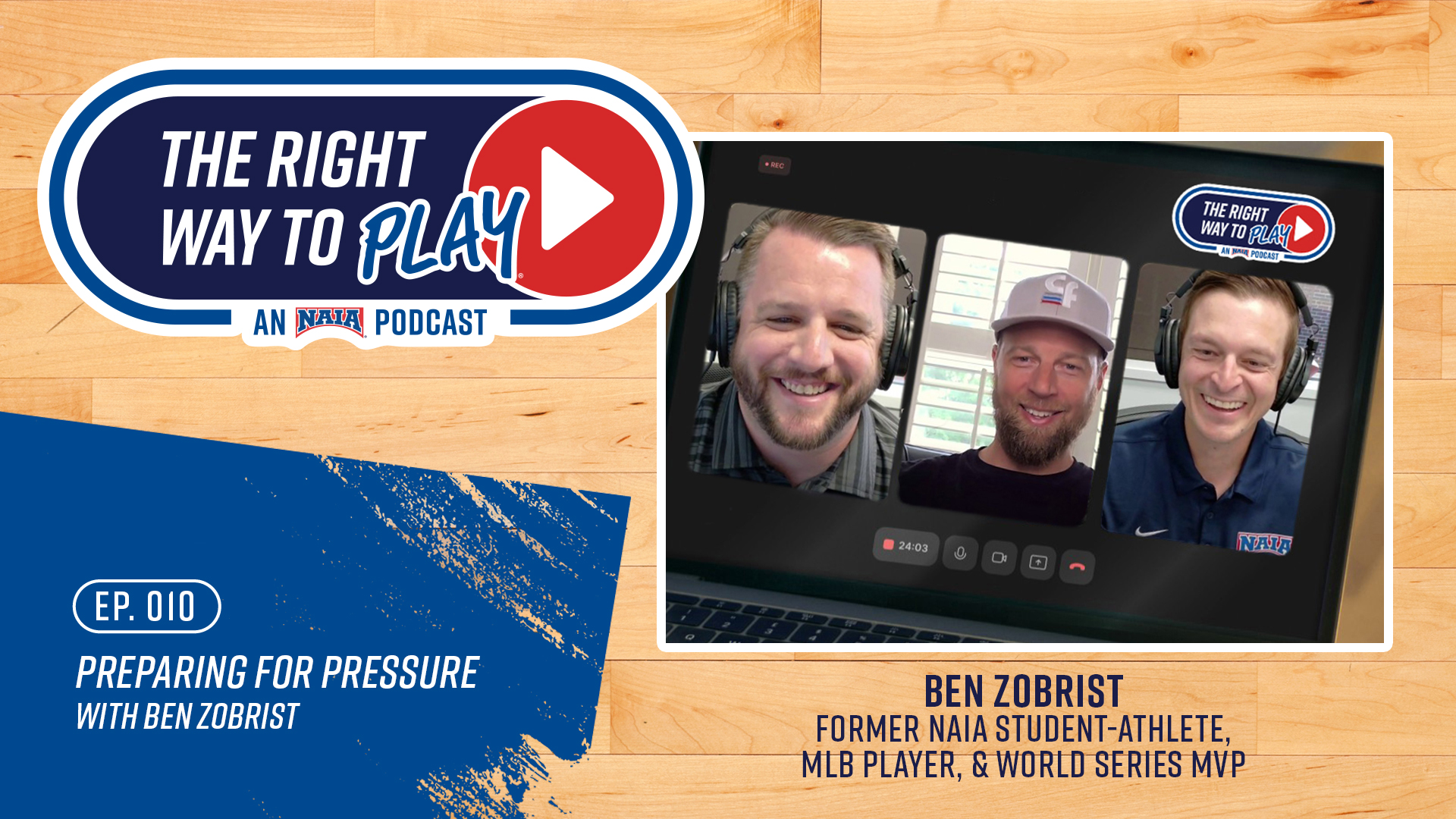
Today’s guest is a two-time World Series champion, won with our beloved Kansas City Royals, a World Series MVP, a three-time MLB All-Star, but before all that, he was an NAI student-athlete. We’re joined today by Ben Zobrist, and we’re talking about pressure, leadership, mental resilience, faith, and why lessons learned through sport matter beyond the scoreboard.
Austin Bennett
So over his 14-year MLB career, played for the Tampa Bay Rays, Oakland Athletics, Kansas City Royals, and Chicago Cubs, earning three All-Star selections and becoming known as one of the most versatile and dependable players in the game of baseball. Before his professional career, Ben competed at the NAI at Olivet Nazarene University, an experience that helped shape both his approach to athletics and his perspective on leadership and personal growth. Today, Ben is an author, speaker, coach, and founder of Champion Forward. a nonprofit dedicated to helping athletes, parents, and coaches pursue mental, emotional, and spiritual wellness through sports. His new book, Prepare for the Pressure, releases July 7th and explores how preparation, resilience, and character can help all of us navigate pressures both on and off the field. Ben, welcome to the podcast.
Alan Grosbach
Welcome, Ben.
Ben Zobrist
Thank you, guys.
Austin Bennett
Well, we’re excited to have you, as Alan mentioned, being here in Kansas City, lifelong Royals fans. Thanks for joining us and thanks for being a part of that and bringing a World Series title to Kansas City.
Ben Zobrist
Man, my time in Kansas City was really special. Even though it was short, it was very special. And a lot of people don’t know this, but I actually grew up; part of my childhood was in Belton, just a suburb outside of Kansas City. While my dad was at Bible college. So I was actually in Kansas City when they won in eighty-five. And as a as a as a four year old I was there, and then I was there as a thirty-four-year-old. In two thousand fifteen, as a part of the team. So it’s a pretty special moment for our family.
Austin Bennett
Love that. So your new book, Prepare for the Pressure, is centered around lessons learned through the high-pressure moments in sports and life. Tell us what inspired you to finally put those experiences and principles into a book form and what really led you to writing it.
Ben Zobrist
Well, I’ve already been trying to plug into the younger generation of athletes with my nonprofits called Champion Forward. And we’ve been trying to really encourage people to be more aware, more balanced, more connected in their sports experience to experience mental and emotional wellness while they’re playing the game, while they’re pursuing their dreams. And we’ve put together some great tools in that program. And the more we work with people and the more chance I have to talk to families that are involved in the sports experience, the more I realize the coaching that’s needed for me to try to put some of those things that I think I was doing well as a young person, kind of figuring out the game of baseball. But then other things that I didn’t do so well, right? So the book has both of those things in it. And it and if I could do something for the younger generation of athletes. I would really want to try to help speed up curb of growth so that they don’t experience some of the same challenges I did. So, you know, my my my challenges in baseball were not just on the field. I had challenges off the field. I had some mental health issues that I struggled with a couple different times during my career. A lot of that was was really, I really didn’t understand what was going on at the time. Right. And so as I journeyed through those experiences, I realized coming out the other side of it, there are a lot more athletes, and there’s a lot more people talking about this issue than they were back when I was playing. And so I’ve got to do something to be a part of the solution and help these younger athletes now.
Alan Grosbach
Ben, you’ve played on some of the biggest stages in baseball. You’ve had a tremendous career. Your journey started in small college sports in the NAIA. Looking back at your experience at Olivet Nazarene, like how did that shape you as a player? How did that time shape you as a person and kind of help build you into what you became and who you are now?
Ben Zobrist
That’s right. Yeah, that’s a good question. The freedom the NAIA had at the time was to be able to do more scholarships for private schools than the NCAA could do at the time. Right. And I was the type of player that I definitely could not afford a private institution. And so Olivet Nazarene provided me an opportunity to not only play sports in college, but also to help get that college paid for with a combination of academics and athletics. The NAIA opportunity at Olivet really offered me this opportunity to kind of grow into myself, not only academically, athletically, but physically. The cool thing was that as I grew physically and I got better at my sport, we made it to two NAIA World Series experiences. And I got to experience success and what it’s like to focus. Like outside of school, I was on one sport the entire time, right? Focusing on baseball. So I tried to get them to let them get me to play two sports, but they’re like, Look, you’re getting part of your scholarship from baseball, so you gotta stick with that.
Alan Grosbach
Fair enough. Fair enough. Incredible.
Austin Bennett
So looking forward, now you talked about how the NAIA had its differences compared to even division one and the others. What about moving forward? You think in the current landscape of college athletics, the NIL, which is pay for play at the higher levels with the NAIA, is still education-based athletics. It’s still trying to prepare the whole person. Going forward, what would your advice be to student-athletes about the NAIA?
Ben Zobrist
I think you must think about what your goals are, right? If money is the driver for you, it’s probably gonna be more attractive for you to try to get some sort of NIL deal. But if you are more attracted to the combination of I wanna play my sport. and be really good at that. And I want to potentially get the opportunity to play professionally, but I also need to pursue this academic side. And the truth is. your opportunity is only as good as you playing your sport and getting on the field. Right? And that’s one of the things I will always tell athletes: how are you supposed to develop if you’re not gonna play? Go to a place where you think you’re gonna play, where you’re gonna have an opportunity to win a spot in the first year. And I think the most important thing. is if you want to have this experience where you’re growing as a player, you’re growing as a person, and you’re experiencing something that you don’t know what the end is going to be, but you have the opportunity to feel the pressure of on-field, in-game: what am I going to do in certain situations? Can’t really do that on the bench. You really can’t. It’s very difficult to find growth as a player when you’re never seeing the field. Go to a program and a coach that you believe, and you trust that when they say you’re gonna play, and you’re going to have a- well, you’re not gonna play, but you’re going to get a chance to earn a spot on the field the first year, go there. That’s your best chance to really grow.
Alan Grosbach
Yeah. Correct me if I’m wrong, but one of the threads of your last answer is something that mirrors or matches up to some of the NAIA core values around the development of the whole person and character-driven competition and opportunity to play, so on and so forth.
Austin Bennett
Amen to that.
Alan Grosbach
Do you see moments in your career where character mattered just as much as talent? Or is there a particular story that jumps out in your brain when you think about both sides of that coin of competition and playing and participating not only in collegiate athletics but at the highest level?
Ben Zobrist
In my career, it became apparent, and if you talk to most professional baseball players who have been around the game for a long time, there’s a big difference between a player that comes straight out of high school and jumps into professional sports versus a player that spends three or four years at least in college sports. And the difference there is after three or four years in minor league baseball. The character is different than three or four years at a college program where you stay in the same program for three years. It’s different. It’s like you can talk to scouts; it is different. Players notice it. Hey, this guy was at this school for three years, then he got drafted. Now he’s making his way up the ranks. The kid tends to be more mature. Why is that? It’s because they had to balance. Academics and athletics. They had to get in line with seniors. They had to get in line with the program culture. They had to buy in to being somewhere for a few years. It’s difficult now for great coaches in college sports to build that sense of culture that we were able to build when I was in college because you don’t know if you’re going to have that kid for more than one year, even if they’re a freshman. You know, the difficult thing now is that kids don’t stay. Especially, you know, these kids that play well don’t stay because, you know, if you play well, then it’s like, well, where now can I go and get paid more? Right? And I think that has created this situation in college sports where now we’ve professionalized this, we’ve monetized this, we’ve made this more of a game of money and how much money I can make now. versus how much I can develop in the next couple years to be ready to make the next jump. Now the next jump happens every year. It’s like, okay, well, how did I play this year? Now where should I jump to? Because I played that way this year. And I just don’t love what that does to kids. And here’s why. If your brain is not fully developed and you’re a young man at the age of 20 years old and you just had a great year at an NAIA school. Everybody might be, and you’re going to have a call from a Division I school that’s gonna say, hey, let’s go snatch this kid, let’s pay him, let’s get him here. You know, he could be the next guy in line for this position or that position for us. Well, sometimes that does happen, and sometimes it works out for players, and sometimes it doesn’t. But here’s the problem I have with it. These kids, every year, making a life-changing decision is very, very stressful. Right now, many of these kids are dealing with that right now. They’re stressed because it’s summer and they’re trying to figure out, okay, well, where am I gonna go next year? And they’re getting calls, and they’re talking, and if they didn’t play well, they’re like, well, where can I go where I like the coach better? You know, maybe that other coach is gonna gonna treat me better. I didn’t like the way the coach. So there’s always an excuse for how you played. There’s always an excuse to leave. Whether it’s good or bad, there’s an excuse. Instead of I’m committed to growing in this program, I’m committed to growing as a person. And that’s where I think an NAIA school and the right way to play mandate really has a leg up on the development of the collegiate athlete. So, you know, it’s a very difficult world for these kids to navigate. And I think. The onus now turns the page a little bit; the onus, I believe, is on the adults in the room, the coaches and the parents that are around these kids, or the primary and secondary attachment figures for these young people, to help guide them into making a decision not because of money. Do not make the monetary decision. Decide because you believe this is the best place to grow as a human being through your sport. If that’s what you really want to do, pick the coach, pick the culture, pick the college that you believe you can grow in. Don’t pick the college that you’re gonna get paid to go to. That’s the challenge these kids have now.
Austin Bennett
Man, such a good answer, such a good answer.
Alan Grosbach
Yes. Yeah, agreed. Agreed.
Austin Bennett
So obviously in this world, to some, pressure could be seen as negative or crippling. certain instances, to others, they see it as pressure as a privilege and something they’ve earned. Your book really reframes pressure as an opportunity for growth. Can you expand on that idea a little bit for us?
Ben Zobrist
I’d love to. I mean, look, People expect you to show up and be at your best. The best version of yourself. Well, let’s be honest. Are we always the best version of ourselves? No, we are not. Okay? So, how do we figure out how to try to become the best version of ourselves? Well, I do believe that the pressure gets the best of us. It’s gotten the best of me many times. And oftentimes, when that happens, it’s because I haven’t realized that pressure has been building up for a very long time. And what happens if you’re just avoiding pressure, but you’re still feeling it? Your body does keep the score. Your body does remember. Your brain does remember. Even though you’re trying to avoid it, your brain will remember, your body will remember. So, you start to wonder, why am why do I feel so tired? Why do I feel so motivated? Why am I always cranky? Why am I always frustrated? Well, there’s a good chance you’ve been feeling pressure, and you’re not actually dealing with it. You’re not actually prepared for it. Right? You’re letting the pressure get the best of you. It will crush you eventually if you let it. That’s the idea behind why we need to prepare for it. Do you want the pressure to crush you, or do you want the pressure to change you? Because it’s coming for you, whether you like it or not. If you are trying to be the best version of yourself, you’re feeling a level of pressure that, especially in the arena of sport, you are feeling the highs and the lows of that. Sometimes it feels great, and you’re in flow. Other times you’re extremely frustrated, and you fail. And this is common for all of us. So how do we become prepared for that? That’s the idea. And so my book, Prepare for the Pressure, really tries to meet: What do we need to become more courageous in this fight against pressure? How do we become more consistent in the way that we’re going about this? And then finally, becoming resilient. Because ultimately, mental and emotional wellness is about being resilient no matter how hard it gets. Because sometimes you can’t control how much pressure. Sometimes pressure’s coming for you, and you don’t get to decide how much you’re gonna be feeling. And so, regardless of how much you’re feeling,
Alan Grosbach
Mm-hmm.
Ben Zobrist
So I learned some of those things the hard way. And I and I expound on some of that in this book. So that’s how I’m trying to help people become more prepared for the pressure they’re facing.
Austin Bennett
So good.
Alan Grosbach
Yeah. And just a reminder, that book comes out July seventh. And I just love the intentionality of the language, right? Pressure, you know, and that word means so much to me as I think about it in our current society and what people are facing on a day-to-day basis. It’s really, really good. And thank you for getting your thoughts out there in that
Austin Bennett
Yes.
Alan Grosbach
book.
Ben Zobrist
Well, thank you, guys.
Alan Grosbach
We’re going to transition you now into what is our fast five? This is a lightning round of questions. It’s supposed to be a little fun. Don’t overthink it.
Ben Zobrist
Let’s go.
Alan Grosbach
What is one baseball superstition you had to follow?
Ben Zobrist
That I always think of other people’s superstitions because if I had a superstition, my superstition was no superstitions. Like I there was everybody had one. Everybody had one, and I was like, I will not let a superstition rule my day. Because so much of being a baseball player is like out of your hands, and you want to believe like I can do everything right and it’s gonna turn into success. You can do everything right, and it turns into failure, right? Which is why superstitions. Give us this chance to feel like maybe we do have a little bit of control. If I put my underwear on this way, work for me. Like I did yesterday, it’s going to do it’s gonna work again today.
Austin Bennett
Ben, favorite ballpark you have ever played in?
Ben Zobrist
Wrigley Field. I mean, you gotta go Wrigley.
Austin Bennett
Got Okay. If you could master another sport instantly, what would it be?
Ben Zobrist
Basketball. Basketball was actually my first love as a sport. I loved that more than I loved baseball growing up.
Alan Grosbach
Okay, so in your big league career, you played every position except for catcher. Which was your favorite?
Ben Zobrist
Shortstop. Shortstop was still my favorite. I mean, I probably was better at second base, but when you make a good play at shortstop, there aren’t many better feelings; I felt like a player. And that’s the position I played growing up and where I started in professional baseball. So probably that one.
Alan Grosbach
Okay, last one. Last one of our fast five: one word teammates would use to describe you during your playing days.
Ben Zobrist
Well, I mean if probably if if you would have talked to coaches, they’d have said neurotic, probably. But my teammates, by the end, my teammates could see the professional side. So they used to call me pro, you know, so very professional in the way that I went about my business. But, but yeah, there were plenty of times where I was so in my head that I probably would have been con considered neurotic for sure.
Austin Bennett
Man, it’s so good. Love that. True pro.
Alan Grosbach
Yeah.
Austin Bennett
Well, Ben, this has been incredible. We really appreciate your honesty, your perspective, the way you continue to advocate for mental, emotional, spiritual wellness throughout sports. Your journey from the NAI to the highest levels of baseball now into leadership and mentorship is such a powerful example of the right way to play. So, thank you so much for spending time. I look forward, I know Alan does too, to reading the book.
Alan Grosbach
Yeah, thank you, Ben.
Ben Zobrist
Well, thank you very much for having me. Appreciate it.
Alan Grosbach
Austin, it’s time for our walk-off moment. This is where we share our thoughts. What’s your takeaway from today, Austin?
Austin Bennett
Really just excitement around the book. I found myself thinking of like four or five stages in my life where I haven’t even read the book, but I think the book could have helped me. Think of 18-year-old Austin. Think of obviously dating my now wife, getting married to my now wife, and then becoming a father. Talk about the different pressures along the way that only one of those has to do with athletics, just the different ways that it comes at you in your life with pressure. And I’m really looking forward to finding some nuggets in this to help with that. So what about you?
Alan Grosbach
I mentioned a little bit earlier that that concept and the intentionality around the word pressure and practicing dealing and coping with pressure, just I can’t I can’t get that out of my head right now. And as I think back to Ben’s answer around know, picking a collegiate situation to develop as a person and as a player, of being central, I just- those two things just seem to marry up so much. And I feel like, you know, in this instant gratification society we live in, in so many ways, like coping with pressure. feels more important than ever. And so I’m echoing your comments. Excited to read the book. July seventh, for those that haven’t heard me say it a few times. think it’s gonna be a good one.
Austin Bennett
No doubt it will be. Well, that’s going to do it for this episode of the Right Way to Play podcast. Huge thanks again to Ben Zobers for joining us and sharing such an honest and powerful conversation about resilience and growth, both in sports and in life. Be sure to check out Ben’s new book, Prepare for the Pressure, releasing July 7th, wherever books are sold. Whether you’re a student-athlete, coach, leader, parent, or just someone navigating pressures in everyday life, this is a conversation and a book that will stick with you. As always, thanks for listening. Thanks for being part of the NAIA family. Remember, there’s still a right way to compete and a right way to lead and a right way to grow. We’ll see you next time on the Right Way to Play podcast.
Alan Grosbach
Hey, and if you haven’t yet, please subscribe, share, and send us your ideas. This is the right way to play.