A: No. The five-season model increases the maximum number of seasons of competition but does not increase or restore terms of attendance.
A student-athlete who exhausts the 10-semester/15-quarter TOA limit during the 2026–27 academic year will not be eligible to return in 2027–28, even if the student has fewer than five seasons of competition charged. To compete under the new model, a student must have eligibility remaining under both the five-season limit and the applicable terms of attendance limit.
A: Yes. A transfer student-athlete who has completed four seasons of competition at an NCAA institution may be eligible to compete in a fifth season at an NAIA institution, provided the student has remaining TOAs and meets all other NAIA eligibility requirements.
Student-athletes transferring from institutions that use an eligibility clock model will be evaluated under the NAIA's definition of seasons of competition.
A: No. The new bylaw eliminates the 20% threshold for charging a season of competition.
Under this model, participation in one or more intercollegiate contests in a varsity, junior varsity, or freshman program will result in a season of competition being charged, regardless of the amount of participation.
The 5SOC model provides student-athletes the opportunity to participate in up to five seasons of competition, rather than preserving or restoring seasons through separate provisions such as the 20% threshold or medical hardship. A fifth season is not guaranteed to every student-athlete; a student must still have remaining terms of attendance and satisfy all other applicable eligibility requirements.
A: No. The bylaw eliminated the medical-hardship process for both NAIA and non-NAIA student-athletes.
A student-athlete who participates in an intercollegiate contest will be charged a season of competition, regardless of whether the student subsequently suffers a season-ending injury. Medical-hardship exceptions are no longer available to restore that season.
This approach reflects the broader intent of the five-season model: to provide student-athletes the opportunity for an additional season of competition while simplifying the rules that determine when a season is charged or may be restored.
A: No. The bylaw retains the current terms of attendance (TOA) framework and does not establish a five-consecutive-calendar-year eligibility clock.
The proposal does not change how a TOA is charged. A student-athlete is generally charged a TOA when the student is identified during a term of attendance, or when the student participates in intercollegiate competition during a term.
A student-athlete may take time away from school or enroll part-time without accumulating additional TOAs, provided the student does not otherwise trigger a TOA through intercollegiate competition. As a result, a student-athlete could use five seasons of competition over a period longer than five calendar years.
A: No. The bylaw establishes five seasons of competition as the maximum permitted under NAIA rules.
Individual institutions may establish eligibility standards that are more restrictive than NAIA requirements but may not establish standards that are more lenient. An institution can therefore choose to limit its student-athletes to fewer than five seasons of competition. The implementation of any such institutional policy is determined by the institution.
A: The bylaw extends the Progress Rule to a fifth season of competition.
To participate in a fifth season, a student-athlete who remains subject to the Progress Rule is required to have accumulated at least 96 semester / 144 quarter institutional credit hours, including at least 64 semester / 96 quarter hours in general education and/or the student's major field of study.
Student-athletes must also satisfy all other applicable academic eligibility requirements.
A: A student-athlete who has earned a bachelor's degree may continue to compete while enrolled in post-baccalaureate or graduate coursework, provided the student has remaining seasons of competition and terms of attendance and otherwise satisfies applicable NAIA eligibility requirements.
Once a student has earned a bachelor's degree, the student is no longer required to satisfy the accumulated-credit requirements of the Progress Rule. The student must continue to meet the applicable GPA requirement and all other eligibility requirements for post-baccalaureate participation.
The five-season model is expected to increase the number of student-athletes competing after completion of an undergraduate degree, but it would not provide additional terms of attendance beyond the existing 10-semester / 15-quarter limit.
A: Yes. The bylaw proposal extends the existing 2.000 cumulative GPA requirement to student-athletes participating in their fifth season of competition.
The requirement applies to student-athletes seeking to participate in their second, third, fourth, or fifth season of competition.
A: The bylaw does not change the existing transfer provisions governing student-athletes who compete for multiple institutions during the same academic year.
Under the existing rules, a student-athlete may be charged two seasons of competition when competing in the same sport at two different institutions during the same academic year. The existing exception for students who graduate from a junior college would also remain in place.
A: No. Exhaustion of an eligibility clock at another athletic association would not, by itself, mean that the student-athlete has completed their eligibility in the NAIA.
For a student transferring from an eligibility clock model, the NAIA will evaluate the student's previous participation and enrollment under NAIA bylaws to determine the number of seasons of competition and terms of attendance used. The student will then be subject to the NAIA maximum of five seasons of competition within 10 semester/15 quarter terms of attendance.
A: Yes, potentially. The expiration of the NCAA five-year eligibility clock will not automatically be treated as completion of the student's eligibility for NAIA purposes.
The student's previous participation and enrollment will be evaluated under NAIA bylaws to determine the number of seasons of competition and terms of attendance used. If the student has not exhausted five seasons of competition and 10 semester/15 quarter terms of attendance and meets all other applicable NAIA eligibility requirements, the student could have eligibility remaining in the NAIA.
A: Yes. Because the bylaw retains seasons of competition as the basis for determining athletic eligibility, the existing non-intercollegiate participation provisions (Article V, Section B, Item 20b) remains applicable.
Professional-level participation and other non-intercollegiate competition could continue to result in a season of competition being charged under the conditions established in Article V, Section B, Item 20b.
A: No. The NAIA Council of Presidents has chosen to retain the current financial-aid policy exceptions. Under these exceptions, a student-athlete who does not participate in more than 20% of the sport’s frequency-of-play limit and does not participate in postseason competition does not count toward the team’s financial-aid limits.
This policy would remain in place even though the 20% threshold would no longer be used to determine whether a student-athlete is charged a season of competition.
What do NAIA members and student-athletes think of the 5 Seasons of Competition?
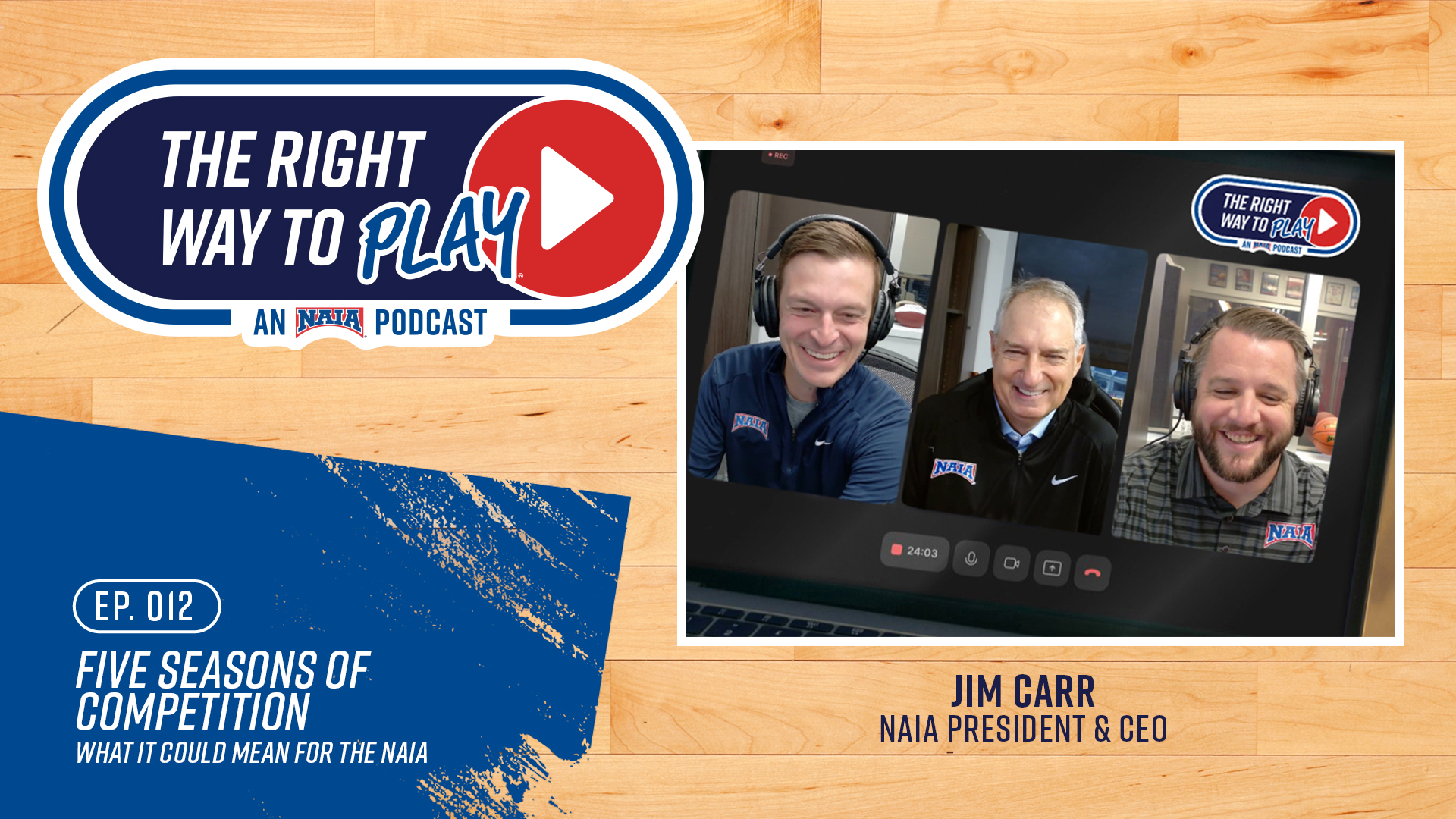
NAIA President and CEO Jim Carr joins Alan and Austin to discuss the potential move to five seasons of competition. They explore why the NAIA is considering this change, the options under review, what it could mean for student-athletes and institutions, and how member feedback will help shape the path forward...