Austin Bennett (00:19) Welcome to The Right Way to Play, the NAIA podcast, where we go beyond the scoreboard to explore college athletics the way it was meant to be. I’m your host, Austin Bennett. In each episode, we sit down with coaches, athletic directors, student-athletes, and thought leaders to talk about building champions on and off the field.
Alan Grosbach (00:28) And I’m Alan Grosbach.
Austin Bennett (00:36) …fostering community through competition and leading with common sense. Whether you’re at an NAIA member institution or just passionate about the future of college sports, you’ll find inspiration and insights here.
Alan Grosbach (00:46) Austin, I think we have a great show today like we have the last few, but I think we need to kick things off with a little segment called Red Banner Rundown. This is where Austin and I share some quick hits, cool stories, cool stats — anything that, I guess, we’re obsessed with right now. Austin, what do you got?
Austin Bennett (00:53) No doubt. Yeah, I’ll start off. We talked about it last time — we are now full-blown into conference play, conference tournaments. We have qualifiers for our fall national championships. It seems like every day we have a new qualifier, whether it’s cross country, soccer, conference championships, things like that. Really excited about kicking off the battle for the red banner here in the fall.
I will say, one thing I do want to share — and I’m excited to debut this fall — is kind of the Disney-model training for student-athlete experience that we did this summer as a Champs team here at the NAIA national office and will be rolling out this fall. The end-to-end design of the experience for both the coaches and student-athletes…I really think people are gonna notice the difference. It’s only going to add to what we’re offering in terms of championships. What about you?
Alan Grosbach (01:38) Yeah, I love that. I am really excited about an individual named Lennox Brown. He was featured in our storytelling series. He’s a wide receiver from Morningside University. He’s second on the team in receptions, second on the team in yards, second on the team in touchdowns — those kinds of things. But what really got me was his quote: “Football has given me the platform, but if all I do is play, I’ve missed the point.”
And I am just obsessed with that quote. That’s a young man who gets it — who gets the power of sports and the power of being a student-athlete at an NAIA institution. For me, it embodies The Right Way to Play. Yeah, I’m jacked up for that individual and really for Morningside football.
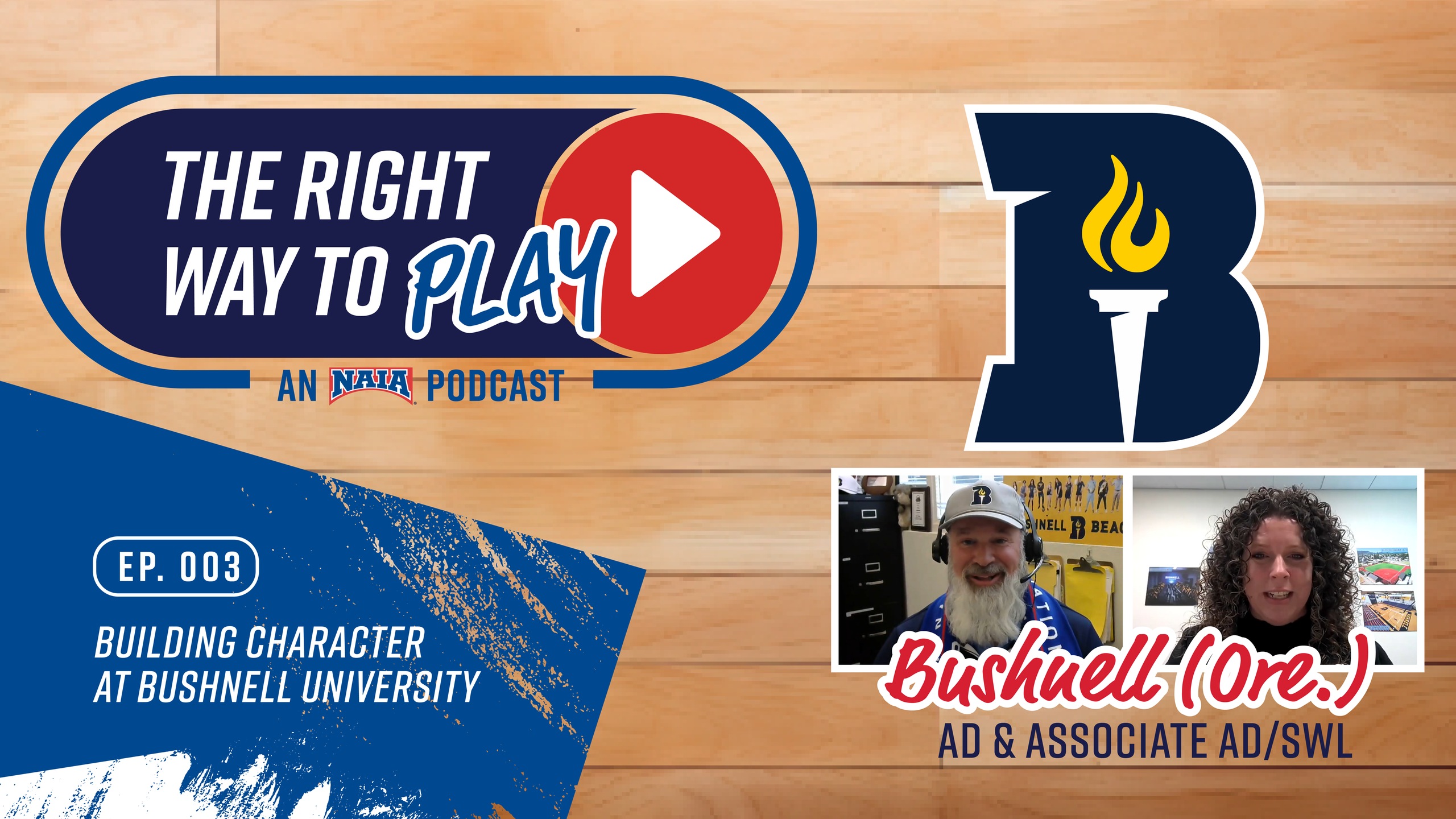
And I think it’s a great segue into today’s episode, where we’re joined by two incredible leaders from Bushnell University — a school that’s really setting the standard across the association for what character in college athletics looks like.
Austin Bennett (02:32) Right, Alan. Please welcome: Corey Anderson, the longest-tenured athletic director in the Cascade Collegiate Conference — a visionary who’s grown Bushnell Athletics from four teams to 17, led the Beacons to national titles, and built a culture rooted in academic excellence, community engagement, and integrity.
And alongside him: Sarah Freeman, Bushnell’s Associate Athletic Director and Senior Woman Leader — the driving force behind the university’s Champions of Character initiatives and one of the most respected voices in collegiate athletics. Sarah’s leadership connects every corner of the department, from compliance and student-athlete success to mission-driven community service.
Corey and Sarah are shaping Bushnell’s identity as the 2025 NAIA School of Character, proving that integrity, respect, and servant leadership can be just as powerful as any win on the scoreboard. Hang the gold banner. Let’s go.
Alan Grosbach (03:12) Let’s go! We’re not worthy! I love this. I’m so excited. Corey and Sarah — great to have you on the pod.
Corey Anderson (03:26) Love that intro. I will say before any questions come up — part of your intro of what this program was about, you said “leading with common sense.” I could tell Sarah had a little look in her eye, like: Are you talking about Corey?
You’re going to have to change that general intro — “leading with common sense.”
Alan Grosbach (03:47) I like it. I love it. Sarah, your rebuttal?
Austin Bennett (03:51) Yes…
Sarah Freeman (03:51) I’m just here to fact-check. So once it’s fully together, I will send in all of my fact checks and you guys can go from there.
Austin Bennett (04:00) Good to know, good to know.
Alan Grosbach (04:00) Perfect. Hey — Bushnell was recently named the 2025 NAIA School of Character. What does that recognition mean to the entire community, not just the athletic department there in Eugene?
Corey Anderson (04:10) Yeah, and we’re an interesting community first and foremost because we are across the street from the U of O, which often puts us somewhat in a shadow. So we really have to create our own environment and establish who we are.
I think receiving this honor as a School of Character kind of substantiated to our student population, to our community, heck — even to our coaches, our current student-athletes, and ourselves administratively — that we are doing things the right way. And we have been doing things the right way over the years.
In reality, I would say this award is a culmination of years upon years. Both Sarah and I have been here for 20 years. And outside of growing our department, we haven’t really changed what we do — whether it’s community service or our commitment to character with our student-athletes and coaches. That’s always been at the forefront for us.
But it’s been pretty cool from a community standpoint. Bushnell has received a lot of recognition — local radio shows, the mayor mentioned it in her address recently. There was a billboard up in town. So yeah, the community has definitely embraced this honor.
It’s been humbling just being part of that.
Austin Bennett (05:25) That’s so cool. And to piggyback on that — obviously national award, national recognition — but what does it feel like to you to be recognized not just by the NAIA nationally, but by your peers in the conference as well? They see you at road events, you see them at theirs. What is it like when you’re competing so highly on the field to have them acknowledge you for this award?
Corey Anderson (05:49) Yeah, I would say humbling. It’s also a constant reminder to our student-athletes. Now that we have this honor, I would say we were always playing with a high level of sportsmanship and character before, but now all of a sudden we’re labeled.
So I do find myself probably a little more sensitive with my ears and eyes on the sideline — making sure someone doesn’t throw this in our face. Because you’re on the field, it’s competitive, and sometimes emotions run high. I want to make sure our coaches and student-athletes recognize who we are and who we’re representing while we’re competing.
Austin Bennett (06:29) Love that.
Alan Grosbach (06:30) Sarah, I’m going to throw this one to you. Corey mentioned earlier about the connections within the Eugene community. You’ve done a lot of unique things — shared facilities, partnerships, all of that. How has that local integration shaped the culture around the athletic department and the university as a whole?
I don’t think people always realize Bushnell is a pretty small campus — and athletics make up a good chunk of it. Not in a bad way, but in a very integrated way. I’m curious from your perspective.
Sarah Freeman (06:59) Yeah, I would say everything we do is with the intent of community focus — of having others involved. From the start, when I meet with recruits or Corey meets with recruits, we always tell them: We want our community to support us. We have to support our community.
And service, in general, is part of Bushnell’s tagline. So it fits really well into the initiatives that we have within athletics. Our triathlete model — for us, centered on Christ — includes academics, athletics, and character. Because we have a holistic approach to athletics, it helps us integrate that and weave it into everything we do.
We are, as Corey mentioned, next door to the University of Oregon. We’re right in the middle of the city. We have a major street that runs through our campus. And by nature of where we’re at, we’re part of everything going on around us.
We’re also landlocked. So all of our outdoor facilities are off campus. We send our students out in different directions. I tell everyone: our campus gets really quiet between 2 and 6 PM because everyone is at practice somewhere in the city.
Alan Grosbach (08:15) Right.
Sarah Freeman (08:19) Whether you’re baseball, softball, track, cross-country, beach volleyball — everywhere our student-athletes are out and about. Our expectation is that they’re representing us well. But we also want to form community partnerships so we can give back to the spaces we’re in.
Our baseball and softball fields were built on school campuses — a middle school and a grade school — with the intention that our students could interact with those kids, and that they could have a vision of what a college student-athlete looks like.
We’ve had a grade-schooler walk with one of our students on Senior Day because he was standing at the fence every day watching practice. So DJ got to walk with one of our girls. We love the community involvement — it’s part of our DNA.
Austin Bennett (09:09) That’s so cool.
Alan Grosbach (09:10) That “it takes a village” vibe fits Bushnell perfectly. I think that’s really neat.
Austin Bennett (09:12) Yes.
100%. The fact that you took what could be perceived as a negative — being landlocked and having off-campus facilities — and turned it into a positive with real community impact…kudos to you guys.
So piggybacking on that: you’ve had incredible program growth — from adding sports to enrollment to facilities. How do you maintain the focus on character and relationships while the department continues to expand?
Corey Anderson (09:45) Yeah, and that’s difficult. I’ve reflected recently — back in the day I was also a basketball coach here. I was an assistant for four years and the head men’s coach for four years. Our department was smaller. Relationally, it was easier. There were fewer student-athletes.
The teams I coached — I had great relationships with. But I also had relationships with a lot of our student-athletes in general. I’m speaking for Sarah, too.
As we’ve grown, it’s tougher. I’m no longer coaching, which means I’m no longer in the gym every day, off the bus with them, on road trips — which is where a lot of memories happen. All of a sudden that doesn’t exist.
We’ve gone from 43 student-athletes to 320. Sarah is much better at names than I am. I’m constantly like: “Sarah, who’s number 17? Sarah, who’s number 23?” And she knows it instantly.
If she ever wanted to mess with me and tell me the wrong name, I’d yell it and look like an idiot. Don’t listen to that, Sarah — no bad ideas!
But that’s the thing: we try to be there and be seen.
Alan Grosbach (10:40) (Laughs)
Corey Anderson (11:04) Like the other night — we had an event called Beacon Madness. All of our teams, music, dancing — it’s awesome. Sarah and I MC that. We get out on the microphones and have fun because it puts us in front of our student-athletes. They get to see our personalities. They’re not always going to see that when I’m standing at a soccer game.
It’s hard. But we emphasize it — we are a relational campus. Athletically, academically, administratively — very relational. We pride ourselves on that.
As Sarah mentioned, almost every student-athlete recruit meets with Sarah or myself. So they know us before they ever get here. And months later at a game, mom and dad will come up and say, “Hey, you probably don’t remember me…” And Sarah immediately remembers their names. I’m like…“Sure, we met. I don’t remember.”
Alan Grosbach (12:15) (Laughs)
Corey Anderson (12:16) That’s important to us. It gets harder as we grow.
And — we also have our kids. Sarah is known as the “snack woman” on campus. She always has snacks in her office. That draws student-athletes to the department pre-practice and post-practice. Some are very consistent. Thankfully, it’s not all 320 of them or we’d go broke. Costco would have to deliver daily.
Alan Grosbach (12:51) Yeah.
Austin Bennett (12:51) We have our own snack woman in our office — Sarah Echinger, who I know you both know. She’s the go-to for candy to keep the office moving. Glad to see it’s not just us — and kudos to you, Sarah.
Corey Anderson (12:54) Of course. It’s a Sarah thing.
Alan Grosbach (13:04) All right, Sarah — I’m going to you because you obviously know the students’ names, so we won’t throw this story to Corey.
Sarah Freeman (13:04) It’s a Sarah thing.
Alan Grosbach (13:11) Bushnell has a ton of inspiring stories around Champions of Character. Is there one that really encapsulates your department and what the School of Character Award is about?
Sarah Freeman (13:26) There are so many stories — so it’s hard to pick just one. When you say names, student-athletes like Sarah Pescosolido come to mind, or Ty Kishin, or Gracie Hamilton in softball. Every team has them — I could literally go through every one of our students.
We have a ton of different initiatives, and we also have graduate student assistants who help out in our office. So…I don’t even know how many hours you want me to spend answering this!
But I’ll go back to our men’s track and field team — they were named the NAIA Male Team of Character this last year. Corey and I got to go to our conference meet, and just watching those guys encourage one another…
We got known as “the clapping team.” As in track and field — jumpers have their own clap. We’ve turned into “Jumper U.” Everyone has their own individual clap. They all know each other’s. They get everyone involved. And they do it for all the other competitors, too.
You can ask Matt Sours, the SOU AD — he laughs at us, but I secretly think he’s jealous.
It’s fun to watch the camaraderie, the impact they have on campus, and within the CCC. When the other ADs talk about how our men’s track team showed up at conference — that’s the stuff that makes me proud.
Yes, we have good jumpers. But I’m more proud of the guys encouraging teammates, praying with another competitor, picking someone up at the end of the line. That’s more important to me. We want to win — but we want to do it the right way.
Alan Grosbach (15:20) Right? Yeah. Infectious energy — that’s what it sounds like. It’s awesome.
Austin Bennett (15:24) Mm-hmm.
All right — let’s move to our Fast Five. Lightning round. No overthinking. Five questions to give listeners a peek behind the scenes. Alan, kick us off.
Alan Grosbach (15:45) Both of you have to answer — no opt-outs. Question one: What’s something unique about Bushnell that people wouldn’t normally know?
Austin Bennett (15:47) Yes.
Corey Anderson (15:56) I sort of already mentioned it — we’re across the street from the U of O. People hear us say that, and then they get here and realize we’re serious. It’s literally right there.
It’s crazy to be next to a Power 4 conference, Nike U — and we build that environment into our campus. We sell the fact that Oregon hosting USC in football…there’s not another NAIA school that gets to feel what that game day is like.
When ESPN GameDay was here, 200 yards from our campus, our whole student population was out there at 5 AM. It’s a unique quality for a small, faith-based Christian university, and we love it.
Not a lightning answer — but there you go. Sarah, you’re up.
Austin Bennett (16:39) That’s incredible.
Alan Grosbach (16:42) Yeah, that’s interesting.
Sarah Freeman (16:53) I would just say the longevity of our staff. Corey, Nick Askew — our assistant AD for communications — and myself. We’ve literally been doing this together for 20 years. To come in and build what we have from scratch, and still be here — I think that’s one of our secret weapons.
Alan Grosbach (17:13) Yeah — shout-out to Nick. Nick is awesome.
Austin Bennett (17:13) So cool. Yes.
Corey Anderson (17:16) Nick’s the man.
Austin Bennett (17:17) All right — next question. It’s midnight and you’re hungry. Where are you going and what are you ordering?
Corey Anderson (17:23) This is a Sarah question — I’m probably asleep.
Sarah Freeman (17:25) That’s true. Midnight is like…I’m just starting to get going. I might just be having lunch at midnight — those are my hours.
I love anything soft-serve. So if I can get a Blizzard — or if I’m not in Oregon, frozen custard is my jam. I love coming to Kansas City so I can get frozen custard.
A concrete — Oreo, banana, and caramel.
Austin Bennett (17:43) What kind in that?
Alan Grosbach (17:49) Banana — curveball. Corey?
Austin is a Reese’s & M&M’s-with-chocolate-sauce guy, not joking.
Austin Bennett (17:49) Alan’s a Reese’s guy, yeah. We know each other well.
Corey Anderson (17:54) Bye!
Austin Bennett (18:00) Lots of travel together.
Alan Grosbach (18:02) Corey, what do you got?
Corey Anderson (18:01) Mine’s probably…let’s see — Burrito Boy might be open when I’m driving home. So I’d swing by Burrito Boy and get something. Local place, really good.
Otherwise, I’m opening up my refrigerator to see what my teenage boys didn’t devour. Maybe an old slice of pizza.
Alan Grosbach (18:14) Fair.
There you go. Austin — you haven’t answered.
Austin Bennett (18:26) I’m the same — if I’m up at midnight, I’m probably laying in bed with one of my daughters who won’t go to sleep. But if I’m eating? I’m going Taco Bell. Taco Bell Mexi-Melts or a quesadilla, something like that.
Corey Anderson (19:07) There you go.
Alan Grosbach (19:11) I love it.
Corey Anderson (19:11) That will get you the next morning.
Austin Bennett (19:13) That will get you the next morning, yeah.
Corey Anderson (19:15) Get you out of bed.
Alan Grosbach (19:16) All right — pivot. If you had to trade jobs with one Bushnell student-athlete for a day, what sport are you suiting up for?
Corey Anderson (19:26) Oh dude — I am going Jermaine Saks-Nider and I’m a triple jumper. All that dude does is walk around campus and he’s friends with every human being. I think he goes to class — I know he goes to class — but he has a rotation of 100 people he hangs out with.
He walks into my office every day like, “Hey, who are you emailing? Who are you emailing?” because I’m always at my computer.
Alan Grosbach (19:50) (Laughs)
All right, Sarah — same question.
Corey Anderson (19:58) I’m going with Ashton Harvey from men’s basketball. Because if you’ve seen me in person, I’m slightly vertically challenged. So being over 6’4″ and reaching anything I want all day long? I’ll take Ashton’s job.
But also — Ashton’s got a sweet mullet. And he’s a basketball player. That’s what Sarah really covets.
Alan Grosbach (20:15) Austin?
Austin Bennett (20:26) You’re really selling it. I love it.
Alan Grosbach (20:28) Business in the front, party in the back.
Austin — what sport are you suiting up for at Bushnell?
Austin Bennett (20:35) Well…seeing pictures and hearing about this golf practice facility, I don’t know how I couldn’t want to be a golfer out there for the Beacons.
Alan Grosbach (20:41) You stole my answer. I want to be on the golf team.
Corey Anderson (20:43) Good choice.
Austin Bennett (20:47) They do have some great facilities.
All right, Corey — we hear you’re basically Bushnell’s Santa Claus. Tell us how that tradition started.
Corey Anderson (20:51) I think there’s a picture around here…right behind me. Here — I’m going to hold this up. This was last year’s Christmas card.
Austin Bennett (20:59) Love it.
Corey Anderson (20:59) The best one — I’m sure you’ve seen it, because it’s on Chesney’s desk. We’ve got a really good one coming this year, too.
So yes — during COVID, this is kind of a heartwarming story — my wife, who is a VP at the YMCA, obviously everything was on Zoom. So I started doing Santa Claus via Zoom for the YMCA so kids had Santa, because you couldn’t go to the mall.
I went to one of the first ones — it was local — and then all of a sudden it got big. The Y never knew where people were registering from. Suddenly I’m in SoCal, the Midwest, New York. It was pretty funny.
And if you Google “Zoom Santa Claus,” I’m one of the top things that pops up — even now, five years later.
I did that for like three years. It was awesome — I’d be on these kids’ tablets, literally in their homes. They’d show me the family dog, the Christmas tree, last year’s presents, what broke…hilarious. I’d do it for hours — five nights a week. I’d work here, then go down to the Y and get on Zoom. Top-half Santa — and wearing shorts because I was on Zoom.
The last couple of years, I’ve moved on to doing business luncheons, events on campus, still do things for the Y, private schools…middle schools, elementary schools…I’ll do things in their classrooms. It’s entertaining.
Alan Grosbach (22:40) If you’re looking for a Santa — sounds like we’ve got our guy.
Austin Bennett (22:43) That’s legendary.
Corey Anderson (22:43) Well, I had never grown a beard before. Then COVID — grew the beard — and I looked like a warlock. It got long. So then it just kind of became Santa Claus. Good excuse to keep weight on.
Alan Grosbach (22:59) Perfect. Last one — one-word answer.
Austin Bennett (23:02) And we emphasize — one word.
Alan Grosbach (23:04) One word. What’s the Beacon Way to Play?
Corey Anderson (23:09) I have a word. Passion.
Sarah Freeman (23:13) Competitive.
Austin Bennett (23:15) Very good. We’ll take it.
Alan Grosbach (23:15) Nice. I like it.
Corey Anderson (23:18) What’s the NAIA one-word? The Right Way to Play.
Austin Bennett (23:21) I’ll go with “character.”
Alan Grosbach (23:22) Awesome. Just awesome.
Corey Anderson (23:23) There we go.
Austin Bennett (23:24) Love that. Well, Corey and Sarah — thank you so much. Thank you for taking the Fast Five and making it just five more questions in addition to the five we already asked. Very thoughtful nonetheless.
Tell our listeners where they should go to stay up to date on Beacon Athletics and all things Bushnell.
Corey Anderson (23:32) Yeah — I’d say BushnellBeacons.com. It’s on the worldwide web. If you click on that, you’ll find everything — schedules, rosters…
Austin Bennett (23:48) Good deal. Our listeners can stay connected there on the worldwide web, and they can stay connected with us at NAIA.org and on social at @PlayNAIA.
Alan Grosbach (23:57) Austin — every game has a walk-off moment. This one’s ours. I’d like to close with our big takeaways from the conversation. What stood out to you today talking to our friends from Bushnell?
Austin Bennett (24:06) The word “relationship” or “relational” comes to mind. They talked about the three of them in the athletic administration being together for 20+ years. They talked about putting that relationship focus into their programs, their coaches, and their community.
That’s one of the things I love most about the NAIA — the relational side. What they’re doing at Bushnell is top-notch.
Alan Grosbach (24:32) Yeah — for me, it’s fun. It seems like the people at Bushnell have a great time and really enjoy one another, both in competition and outside of it. It’s inspiring and energizing — that stood out.
Austin Bennett (24:48) Absolutely. Well, thanks for joining us on this episode of The Right Way to Play podcast. We hope you enjoyed the conversation and got a glimpse of what makes college athletics so powerful.
We’d love to hear from you — your thoughts, comments, even ideas on future guests. Drop us a line at therightwaytoplay@naia.org and help us shape where this podcast goes next.
Alan Grosbach (25:06) Until next time — keep playing the right way.
Corey Anderson (25:08) Go Beacons.