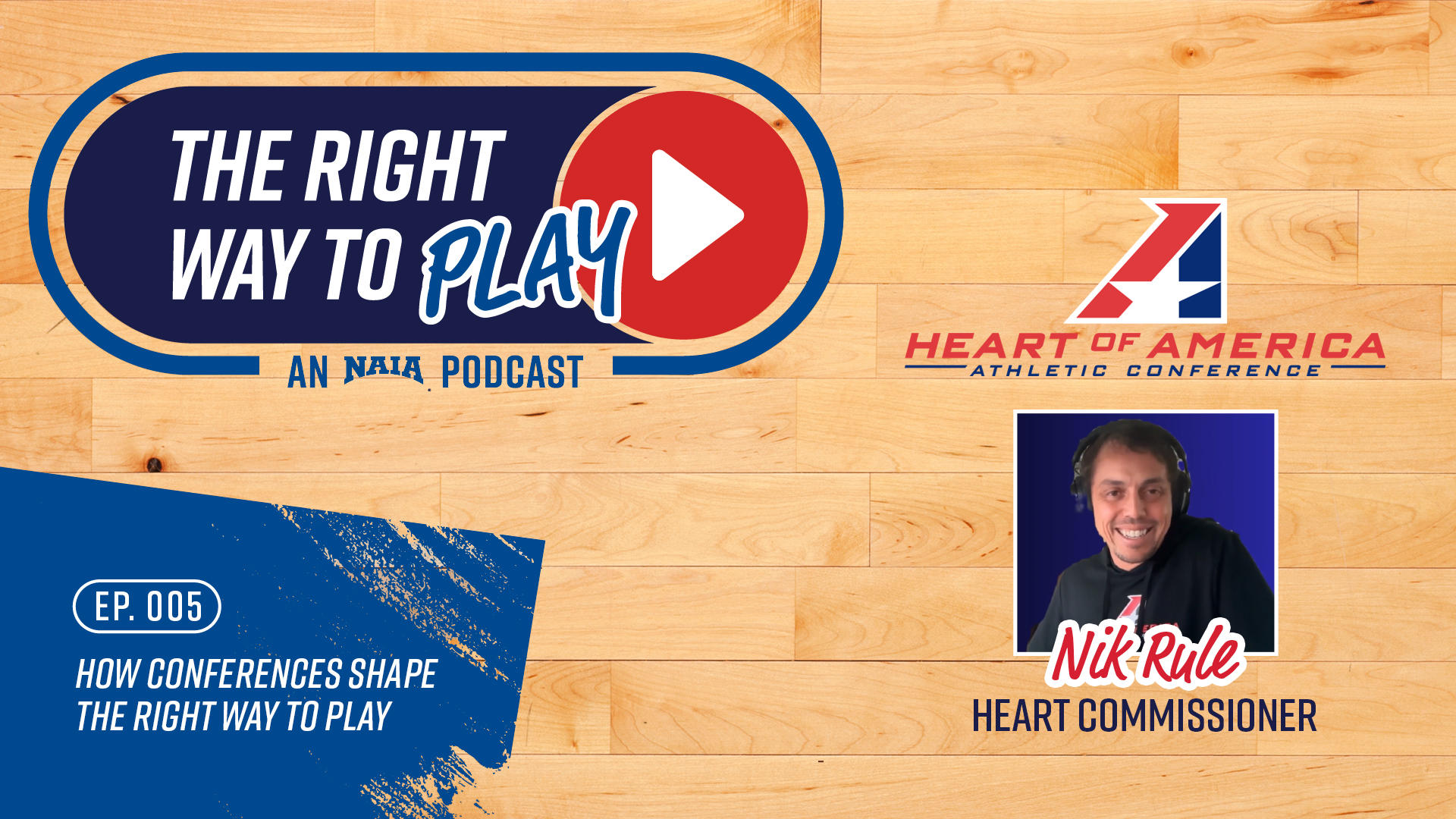
What happens when leadership, culture, and competition all point in the same direction? You get The Right Way to Play, and conferences play a bigger role than most people realize. In this episode, hosts Alan and Austin sit down with Nik Rule, Commissioner of the Heart of America Athletic Conference, to explore how conference leadership helps set the tone for sportsmanship, student-athlete experience, and community impact across member campuses.
Austin (00:18) Welcome to the Right Way to Play, the NAIA podcast, where we go beyond the scoreboard to explore college athletics the way it was meant to be. I’m your host, Austin Bennett, alongside Alan Grossbach. In each episode, we sit down with coaches, athletic directors, student athletes, and thought leaders to talk about building champions on and off the field, fostering community through competition, and leading with common sense. So whether you’re at an NAIA member institution or just passionate about the future of college sports, you’ll find inspiration and insights here.
Alan (00:46) And Austin, like we always do, let’s kick it off with the Red Banner Rundown. This is where Austin and I share some quick hits from around the association, cool plays, big things that happened, or just a flat out awesome story. Austin, what do you have for this episode?
Austin (00:59) Well, I’d be remiss if I didn’t start at least with a recognition of our fall national champions, our red banner winners from the fall. So congratulations to those universities on raising the red banner and winning the ultimate prize in college athletics at the NAIA level. And I want to jump quickly to something that happened this past weekend. Boyd Picken has earned a top NAIA honor. He’s at Avila University as an assistant AD and was just recently named the 2026 recipient of the Robert E. S. Smith achievement award for the sport of baseball.
It’s one of the most prestigious honors for service, leadership, and dedication to baseball and the association. He’s had such an impact over the course of a couple of decades, not only on campus and coaching his teams, but he’s a mainstay out in Lewiston on the games committee for the World Series. So shout out to you, boy. Congrats on the award and congrats to all our teams that won a red banner this past fall.
Alan (01:44) Awesome. Yeah. Congrats to Boyd. Boyd is an institution when it comes to NAIA baseball and always thankful to get to interact with him around the World Series and other other times throughout the year. Mine, we’re to go back to November, but this was just such a cool story and we didn’t mention it before. Grace College, women’s hoops, scored 172 points in a single game. Wow. This is a new women’s basketball scoring record across all divisions, all divisions.
Not just to win total headline maker. Congratulations to the Lancers. That was an incredible game. I would have been curious to be in the stands. I think they forced like 42 turnover. just shots on shots on shots as, Jim Carr always says, “You shoot to get hot and you shoot to stay hot”. So congratulations to Grace college. What an incredible feat. I can’t even imagine 172 points.
Austin (02:36) Just wild quick math if they just made all twos, that’s like 86 two point shots going in. How long do you think it would take you to make like 86 layups like me personally more than 40 minutes? That’s a basketball game more than that.
Alan (02:48) 86 minutes. I’m not very good.
Austin (02:50) take you at least 200 shots to make 86 of them. like, let’s get a factor that in.
Alan (02:55) Yeah, it’s it’s chaos. It had to be chaos. Beautiful basketball chaos. And as a fan of like offensive basketball, like sign me up. Let’s let’s get some high scoring games.
Austin (03:06) Shout out to the Lady Lancer basketball program. Big time.
Nik (03:08) Yes.
Alan (03:09) Alright Austin, on today’s episode we’re going to take a closer look at how conferences help shape the culture of collegiate athletics and here within the NAIA share a commitment to the right way to play. It’s a conversation about leadership from behind the scenes and the ripple effect it has across the campus and every game.
Austin (03:26) That’s right, Alan. And today’s guest is Nik Rule, Commissioner of the Heart of America Athletic Association since February of 2024, following seven years as Director of Athletics at William Penn University. He’s a longtime leader in the NAIA. He served on numerous committees, including Champions of Character®, Championship Selection, Marketing, Revenue Generation, and Drug Testing. Within the Heart, he has supported multiple sports, the Association of Student Athletes, and the conference’s conduct and ethics efforts, while also representing the conference.
on the National Administrative Council. While at William Penn, Nik oversaw 27 programs, added six new sports, elevated academic performance to historic levels, and helped drive a record competitive success and enhanced game day experiences. He’s also served as head women’s golf coach, earning multiple conference titles, national appearances, and the NAIA team of character honors. Known for his student athlete first mindset and culture driven leadership, Nik continues to champion excellence, integrity, and the values that defined the right way to play. Welcome, Nik Rule.
Alan (04:27) That is a bio! Man, Nik, welcome!
Austin (04:30) Man, I did that in one breath, feel like. One take for sure.
Nik (04:33) Wow, that’s Austin. Wow. Thanks, man. I’ll buy you dinner when I’m in Kansas City next time.
Austin (04:40) Well, I think we just took it from what you put out there. So thank you to you, I guess, on that for championing that. So no, it’s great to have you. Thanks for joining us. We’re excited for this episode, especially coming out of the holiday break. feel like heading to the second semester. What better way to start than with somebody as forward thinking and as progressive as you. So thanks for being here.
Nik (04:58) I’m excited and I love what you guys are doing. The, Allen and Austin show or Austin and Allen show. When I heard the announcement in the fall meetings, I saw the sticker and I like, this is going to be gold. So the fact that I’m an early guest, am honored. I can’t wait. I can’t wait for all my friends in the association to see this, especially like Drew Watson and folks like that. let’s go.
Austin (05:19) Right, right. Well, let’s jump right in here to the questions. First up, Nik, the Heart had a great fall, obviously as you’re as aware, multiple teams in national championships, semi-finals, national championship fields overall, and ultimately two national champions in the Grandview men’s soccer program and the Grandview football program. Outside of those things, can you tell us about some of the great things happening in the conference from this past fall?
Nik (05:41) We’re really proud of our success nationally as you’re kind of alluding to here, but I think a little bit of what you don’t see and I think it’s a little bit of what we want to talk about today, just kind of behind the scenes, what that looks like. mean, yes, we’ve had a great fall. I mean, just in general, for years we’ve had a lot of success. mean, five out of last eight national champions just invent soccer from the heart. But for us, it really goes on much deeper than that. Outside of those things, what really tells the story of the great things happening in the conference.
You know, we’re very fortunate to have United membership that’s really COP led, a meteorites deal that’s helping in the goal of really reshaping intercollegiate athletics, which is one of our goals. The student athlete development program that’s revolving around internships within our conference and 15 schools, 15 interns, a virtual internship fair with all of our partners so we can do job placement for our student athletes, a leadership academy where we can continue to invest in all of our
probably close to 10,000 student athletes now. We believe we have an excellent membership that are really hungry for leadership in the conference office. And I’ll share with you a little bit of perspective on this. Jim Abbott, who’s a long time NAIA legend, my Oklahoma City University retired a few years ago as the Athletic Director. He’s been a mentor of mine. And one thing that he shared with me when I started in this role, moving from the ADA to Commissioner ranks was he said, call, ⁓ not in the NAIA, call Commissioners of a different associations, reach out to them and ask if they can, they’ll have a conversation with you.
And so I did, and I had 30 different commissioners respond from other associations and just to kind of pick their brain on like, how does this whole thing operate? And one thing that we learned is that, you know, I learned that there’s conferences that have executive level leaders and those conferences are having a lot of success. Their Commissioner acted as an executive. And then there was conferences that are operating in the corporate setting of coordinator. And I had spent a few years in the corporate setting of Musco Lighting at the start of my career. And you know what a coordinator was, you know what someone in an executive level director title was.
And so it was very interesting. One of the things that I learned very early on is that the conferences that were really growing had that executive level leadership and the conferences, those Commissioners that were talking to me about worries about membership loss, those are the ones that are acting as coordinators. So we really strive to improve excellent governance and internal operations, that internal pathway to connection. We believe that conference offices are focused on galvanizing people and bringing people together.
Our approach is very big picture and we’re in a process of reimagining how things should be approached from communications, investing in creative content, partnerships. And so I’m very proud of what we’re doing externally, but I think I’m equally proud of what we’re doing internally within our conference office with their United membership and NAIA AD group and a president’s group that is really, really believing in what we’re trying to do.
Austin (08:25) That’s amazing.
Alan (08:26) Yeah, Nik, let’s talk a little bit more about your kind of journey to the Commissioner role and get a little deeper into your approach. Obviously you came to the NAIA as a student athlete, you were a coach, you were an AD, now you’re the Commissioner and you kind of shed some light on this conversation you had with people outside of our ecosystem and your conversation with Jim. But talk a little bit about how just your background across multiple… levels or areas of the association is influencing how you approach the conference office work today.
Nik (08:56) I feel very blessed to have, you know, a very unique view of things from, you know, really four different capacities that I’ve really served in within the NAIA. And I’m a very passionate NAIA person, but I’m really passionate about small college athletics. So, you know, even at a fairly young age professionally, not being too far removed from, especially the AD role and a little bit more removed from the coach’s role, but I think it’s kind of given me a unique opportunity to kind of still think like a rookie.
I was really told early on by someone who I worked for his name is Matt Ellenberger. He has been a really big piece of my life. He was my first boss, first manager at Musco Lighting. And he always said, you know, if you can spend some time in an organization a long time and still think like a rookie, you know, that’s an absolute masterclass on how to be able to continue to evolve as a professional. And so I’ve really tried to continue to try to think. I mean, remember when we rookies, when we just started something, we’re like, we’re so energetic. We’re so excited. Yeah. We had this like this fire to like.
innovate and do different things. And so I’ve tried to keep that within myself. I think just my NAIA journey and being able to go through these different levels has been very helpful. And moving from the AD role into this to having that prior experience as a coach and a student athlete, I can understand and I’ve sat in everyone’s shoes. And so I actually think coming from those ranks into the Commissioner role is actually a little bit of a cheat code.
Alan (10:12) Awesome.
Austin (10:12) Interesting point. Yeah, no doubt. So higher education and college athletics are going through a transition, obviously, NIL conference, realignment, enrollment, cliff, etc. How how are you thinking about all of this at the conference level?
Nik (10:26) Man, I see this just as an absolute major opportunity. We’re in a time of broad societal re-imagination. Everything, whether it’s in our politics, our media consumption, or even the way we think about higher education, everything is really being rethought. I mean, from just the political standpoint, 10 years ago, you had people that would never agree with each other politically that are in the same alignment now in today’s day and age. So I think about this, and this is gonna kinda give you an insight into the…
type of person I’ve been wired in my whole life guys. I think back in 1998, I was 11 years old and I was this kid running home to watch the nightly news for updates on big world events. And this has probably been the first and last ever reference you’ll have on this podcast, Desert Fox. But I remember watching CNN and watching the U.S. military intervention at Desert Fox. I’m sharing this with you of a purpose behind this because that was the way you consumed media.
Right. And so now what we’re doing in today’s day and age is that everything has changed. Everything has shifted. You know, as a person who was, you know, even at 11 years old, was watching the nightly news and watching a 24 hour news cycle last night, I’m putting or a few nights ago, I’m my daughter to bed and I’m on Twitter getting updates on what’s going on in Iran. Okay. So how does that really work with going on with what we’re doing today is that we are absolutely in the midst of just a societal change and how we consume anything and everything.
and it’s changing our ideological approach to everything. And so in The Heart of America, where that looks like for us with NIL alignment or realignment, the enrollment cliff, it’s a chance for us to highlight the unique view of small college athletics and how everything’s shifting. So if you take my little approach that I talk about news in 1998 and you identify it to college athletics today, there is an absolute argument that you can make. And we are feeling, you can just look at our viewer numbers, on UEN, that people are
looking at college athletics differently, someone who may have just watched Power Five or Power Four stuff 10 years ago is now very interested in the purity of what’s going on and what we’re doing today. So again, consumption is changing and the way that we traditionally viewed ourselves is changing and that’s because we have access to more information and we have access to whenever we want. And it’s educating us in a different way. So we look at this all as opportunities. And so when we look at NIL, finding the right partners, when it looks at conference size,
Some people look at that if they haven’t done enough research, like you’re gonna get too big. No, we can get to the right size to where we can control costs by strategic scheduling, alliances when it comes to pod scheduling and different things, and then investing heavily in creative content to be value added in the recruiting and retention process. And so our schools are gonna go out and recruit their student athletes. We can’t recruit for them. But if we can be value added as a conference and providing a high level experience across a lot of different buckets, we’re gonna help with recruiting and retention.
And so those, in other words, we’re in a period of change and it’s a chance to show exactly that we’re in the right place to be. And there’s a purity in a community in small college athletics that people are really starting to appreciate now more than ever. And that’s because of those really demographic shifts in the societal changes.
Alan (13:26) Nik, how you brought along your schools with all this change? Have you received much pushback from your leadership on campuses? mean, Higher Ed is traditionally very slow to move and innovate, which is an unfair oversimplification of how it works. But that’s kind of an opinion of it in the past. Have you received much pushback from your executive leadership or have they pretty well bought into your vision of the changing landscape?
Nik (13:52) I’ll push back a little bit on saying that maybe it’s an unfair assessment of higher education. It’s actually a very fair assessment of higher education. It doesn’t move very fast in many cases, which is why I think, I view The Heart of America is being so blessed because we are, I said at the start, we’re unapologetic about being an administrator run league and our COP is at the top of that. And so, we have communicated a vision.
on what we think that we can do within The Heart of America and our COP has been very engaged and our board of governors very engaged in the process. You we’re not a coach friendly. There are a lot of leagues out there. They’re coach run lakes. I think that’s a recipe for failure. All right. Coaches have a very important piece in a governance process and a very important piece in what they do every single day. But at end of the day, administrators have to lead. We’ve always been that way in the heart and we’ve kind of doubled down on that in the last few years. And so, you know,
When I was hired, one of the things that was really attractive about when folks were talking to me about the opportunity was we want to take this to the next level. And we are being very passionate and Alan and Austin, I know I’ve talked to you about this. Like we’ve used the word as destabilizing. We use the word as we want to reimagine. I’ve said that a few times, but we, we, we want to shake the system up and lead in The Heart of America and shaking that up because we have a unique mode in time that we have to meet the moment and
Our COP has been very supportive of that. And so they’ve been all in on how do we innovate? How do we change? But at the end of the day, how do we lead? Like we’re, we have leadership. Leaders want to lead leaders. It’s about showing up. It’s about being involved. It’s about imagining where we can go. No one, no great leader sits back and says, yeah, I just want to be the same that I was two years ago. Absolutely not. I mean, but that is a mentality that we have to change at small college athletics because it’s small college athletics for years at multiple divisions.
That’s been the mentality. Let’s just sustain. Sustaining doesn’t work. And we’re in a moment of time where we can elevate.
Alan (15:49) Let’s talk a little bit about The Right Way To Play. What does that mean to you in your conference? You’re talking about elevating, you’re talking about destabilizing, you’re talking about innovation as you talk about your approach to The Heart. What does that phrase mean to you in the conference?
Nik (16:06) mean, it’s really a guiding principle in many cases. It’s well beyond the game itself. You know, it’s that integrity sportsmanship that truly representing our values on and off the field. And we all know that. But even more, I mean, I think, like I’m a big believer in the Champions of Character® program, and you can build the right way to play and piece it in to support that program. But I think in this moment in time when college athletics is under siege from so many different pressures, you know, the right way to play really means being more focused on giving more opportunities, not taking them away.
It means investing in emerging sports, not just the ones that make the major networks happy. It’s about community investment in education rather than venture capitalists focused on profits and college sports. In other words, it’s really about teaching young people the values that can change their lives rather than being dictated by what the market says just to win a game. And it’s about creating an environment where high level competition is a centerpiece of and great champions or championships are part of a bigger mission. We want it to feel big time where we’re at.
while staying true to our values to make the small college athletics what it is so special. We don’t want to change that. And so in The Heart, we’re embracing the right way to play and what that means in a multitude of different ways. And in this unique moment in time, it means a lot of different, very, very important things.
Alan (17:18) Yeah, I love that. Gosh, could high five and chest bump you right now.
Austin (17:24) Inject that into my veins, please. Holy cow.
Alan (17:26) Let’s go. I think you’ve transitioned us perfectly into our character break. And this is where we spotlight one of the five core values of the NAIA’s Champions of Character® program, the values that shape how our student athletes train, compete, and lead.
Austin (17:41) That’s right. Today we’re spotlighting servant leadership. The idea that leadership isn’t about position or spotlight. It’s about impact. And the NAIA leadership shows up in how athletes lift teammates, how coaches serve their programs, and how schools invest in their communities. It’s choosing to lead by example, put others first, and make people around you better on the field and beyond it. That’s servant leadership, and that’s the right way to play.
Alan (18:05) Love it. I feel like we need a sound effect right now because it’s time for the Fast Five
Alan (18:13) Five questions, no overthinking, Nik. First gut reaction. These have tended to be more of a moderate to slow five, so we’re gonna do our best to make these a fast five.
Austin (18:22) It’s a new year, a new year, a new time frame.
Nik (18:24) It’s a new year.
Alan (18:25) A new time frame and hey, a new guest. That’s right. All right, five question number one. Best road trip food.
Nik (18:35) Man, we have 15 members, but I’m gonna go Jack Stack, Mueller’s Pub, TikTok, Buzzard Billies, and Joe’s, all right? And then leaning side at Missouri Valley and Bridges Public House. There you go. You can look up where the. I got more, but those are good ones. And those are all around our membership.
Alan (18:48) He named them all. I might have to have you write those.
Nik (18:55) Yeah, and I used to do on Instagram, and I’m going to start this back up after this question. ⁓ I used to give reviews on all these locations. So I’m going go back to this. So go follow me on Instagram and you’ll see Heart of America Conference Print Food. There you go.
Austin (19:10) Love it. Good plug. All right, number two, most used phrase in the Commissioner’s office.
Nik (19:17) Yeah, “Elevate” because psychologically we’re really trying to redefine what conferences offices produce. So, and we want that loud and clear throughout membership.
Austin (19:26) Elevate, love it.
Alan (19:27) Awesome, elevate. Favorite heart social media challenge.
Nik (19:32) And we’ve got a lot of really cool contents, things going on. But 15 schools in 15 seconds, go on our Heart of America Instagram page. We’ve got a few really cool ones that are up that have a lot of views, but that one’s pretty funny.
Austin (19:44) Favorite under the radar golf course in the Midwest.
Nik (19:48) man, this one was really hard guys, but Blue Top Ridge, you guys know me, I love golf, you guys love golf, but Blue Top Ridge in Riverside, Iowa, Mozingo Lake near Maryville is another one in Paradise Point in Smithville, where it’s just where we’re hosting our conference championship.
Austin (20:03) Bonus question to follow that up. You could only play around with one club in your bag. What is it?
Nik (20:09) Probably an eight iron. Wow.
Alan (20:12) What would you pick, Austin?
Austin (20:14) Probably a five iron. I use my five iron to hit it roughly 200 yards, but I also use it to chunk it out from behind the tree and things like that. So that’s probably my most versatile club. What about you?
Alan (20:25) I love that small flex on how far he hits his five iron too. Seven iron for me, seven iron. That’s my go-to. Okay Nik, last question. What’s one sport you wish every athletic administrator had to play for one season?
Nik (20:37) Ice Hockey
Alan (20:40) ⁓ I want to see Troy Plummer on skates. I’m not convinced that’s that big.
Nik (20:45) Someone who’s played hockey since I was four or three years old. would love to see Troy Plummer on skates as well. And I’d love to be right across from him. Let’s go Troy.
Austin (20:54) Let’s get that challenge. We’ve got a few challenges on here. There’s one thrown out for this. Ice hockey and Troy Plummer. I love that.
Alan (21:01) Nik, thank you for your time today. So appreciate you joining the podcast. Awesome to talk with you. Great things coming out of the Heart of America Conference and appreciate your time today.
Austin (21:10) Yeah, congrats, man, on your success. We really appreciate it. You’re forward thinking as you talked about. you’ve said it a lot, but you are absolutely elevating the conference and the NAIA through your work. So kudos to you,
Alan (21:20) Austin, as we do every episode, it’s time for our walk off moment. This is where Austin and I close the episode by sharing our biggest takeaways from the conversation today. Austin, what stood out most for you?
Austin (21:29) I think it’s the word elevate. mean, he talked about it. What he’s done in his, in his two years with the heart, the buying he’s got, the way he’s pushed. talks about thinking like a rookie. Well, it’s easy to do when you have, you know, the years that he has at different positions, but he’s absolutely elevated the conference and what they offer. And it’s, it’s bled into the association overall and he continues to push. And so that’d be my one big takeaway.
Alan (21:51) Yeah, I’m in a very similar place. mean, you could just feel the energy coming out of him when it comes to how he thinks about collegiate athletics and the things, the way he’s approaching conference leadership. I love this concept of thinking like a rookie, bringing good energy and positive energy and innovative energy to the workplace on a daily basis from his perspective. That’s, I think, something we could all kind of implement as we think about collegiate athletics and the NAIA and the right way to play.
Austin (22:17) Absolutely. Well, thanks for joining us on this episode of The Right Way to Play podcast. We hope you enjoyed the conversation, got a glimpse of what makes college athletics so powerful. We’d love to hear from you, your thoughts, comments, even ideas on future guests. So drop us a line at therightwaytoplay at NAIA.org and help us shape where this podcast goes next.
Alan (22:36) Until next time, keep competing with character, leading with purpose, and always playing the right way.
RELATED NEWS
From UFC to the NAIA: What Great Leaders Know About Winning the Right Way
What happens when a leader leaves the high-stakes world of professional sports to oversee one of the NAIA’s most historic conferences? In this episode, KCAC Commissioner Brandon Buchanan shares how his journey from the UFC Anti-Doping Program to collegiate athletics shaped his perspective on leadership, integrity, culture, and the student-athlete experience. It’s a conversation about […]
What does it take to perform when the pressure is at its highest? On this episode of The Right Way To Play Podcast, we sit down with former MLB All-Star, two-time World Series Champion, and 2016 World Series MVP Ben Zobrist to talk about pressure, purpose, mental resilience, and the lessons sports can teach us […]
009: Strong on the Outside: The Mental Health Reality of Student-Athletes
Behind the competition, the pressure, and the performance, there is a side of being a student-athlete we do not always see. In this Mental Health Awareness Month episode of The Right Way to Play® podcast, we sit down with Samantha Silver, former NAIA student-athlete, coach, and now Student-Athlete Mental Health Coordinator at Bushnell (Ore.), to talk about what […]
008: The Right Way Forward: From the Room Where it Happens
Recorded live at the NAIA Convention, Episode 008 of The Right Way to Play Podcast brings together voices from across the Association to explore what’s next for NAIA athletics. Through a series of short conversations, leaders representing governance, campus leadership, and student-athletes share their perspectives on The Right Way Forward, and how the NAIA continues […]